
魚図鑑のイラストは、種によって「白背景版」と「生息イメージ版」の2枚を用意しています。前回の200種に続いて、今回はさらに199種が2枚立てになり、合計2,689種になりました。収録種数は約2,939種のままで、種の追加はありません。
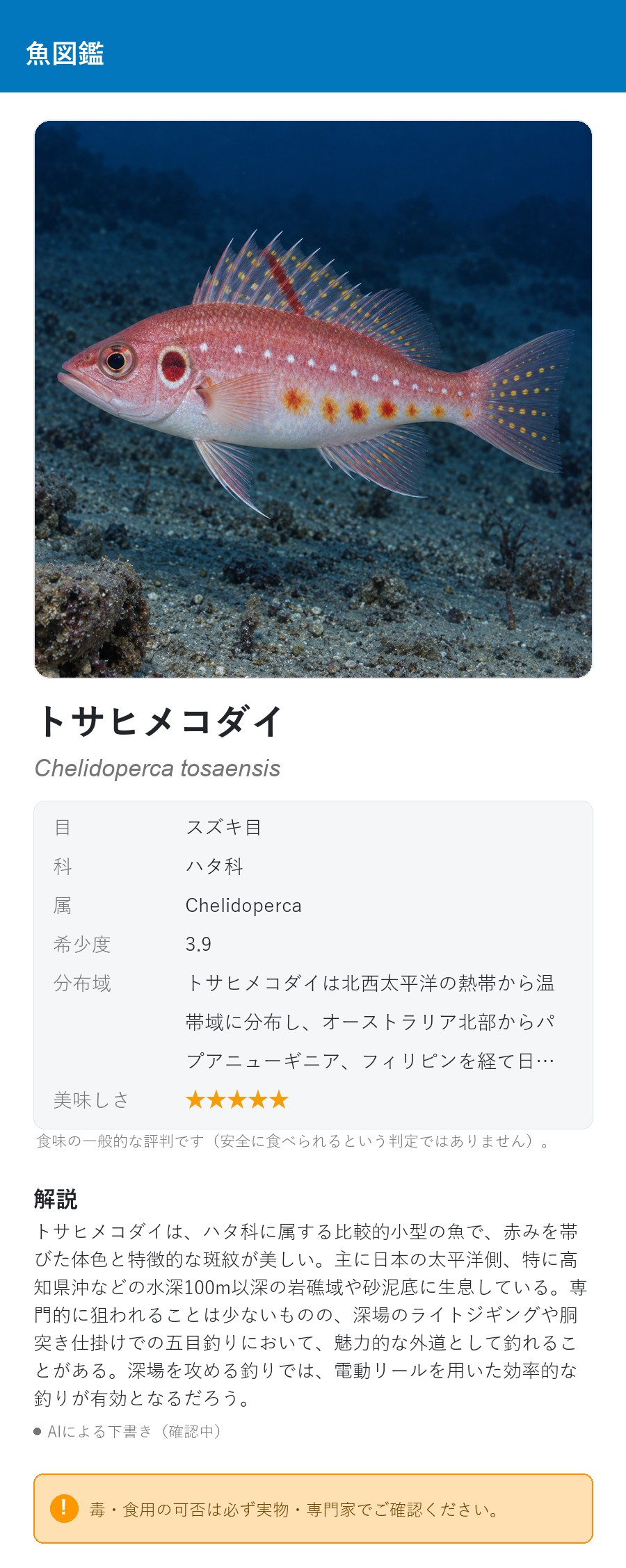
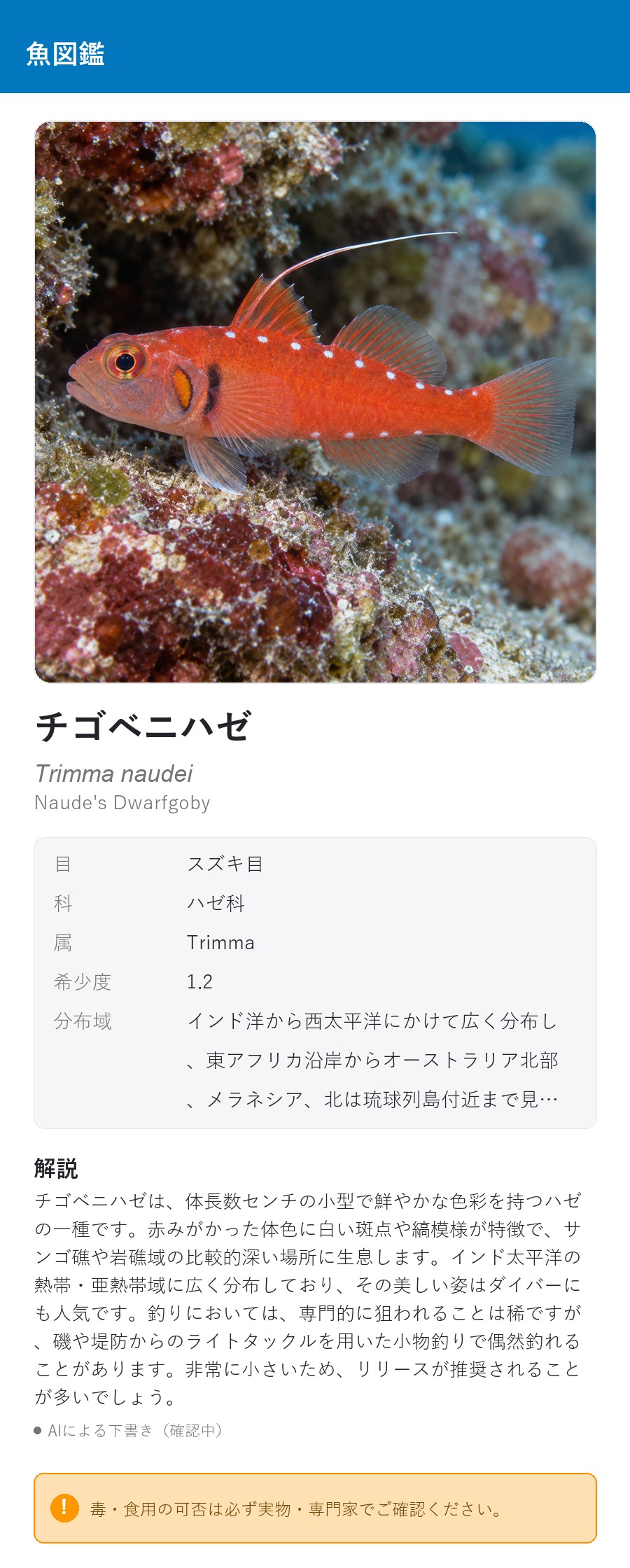
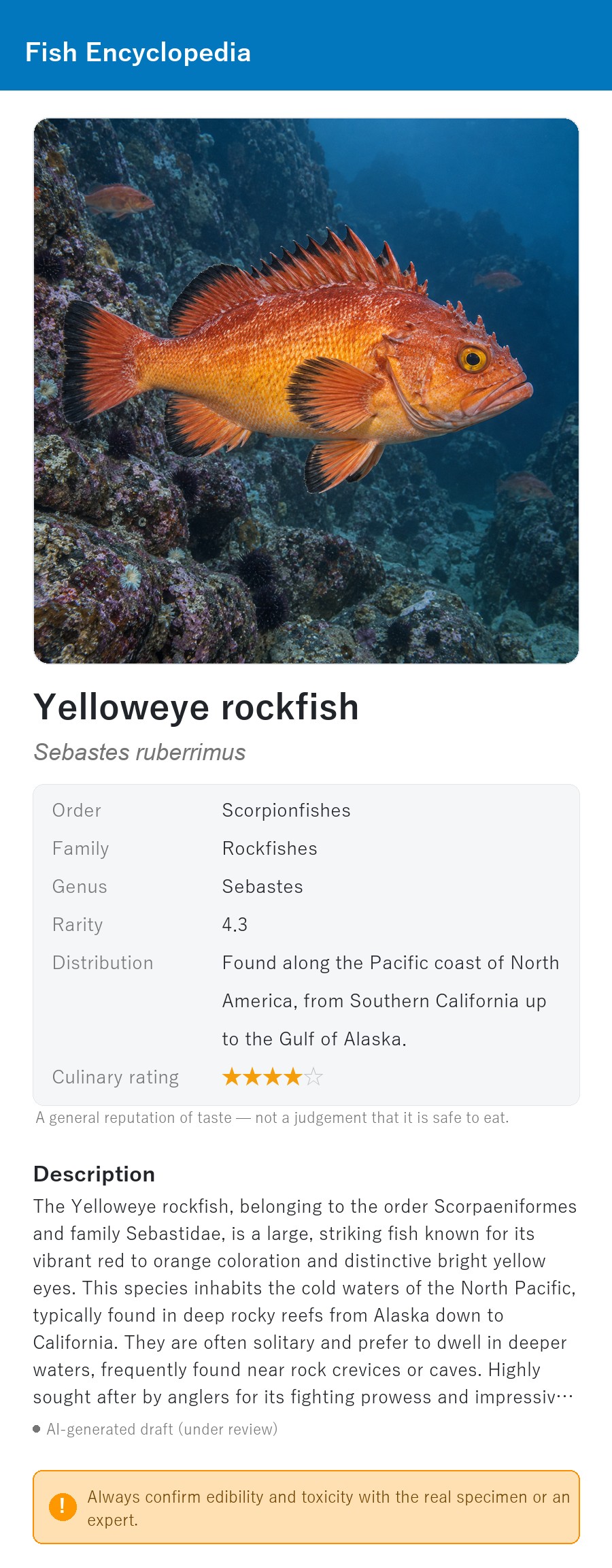
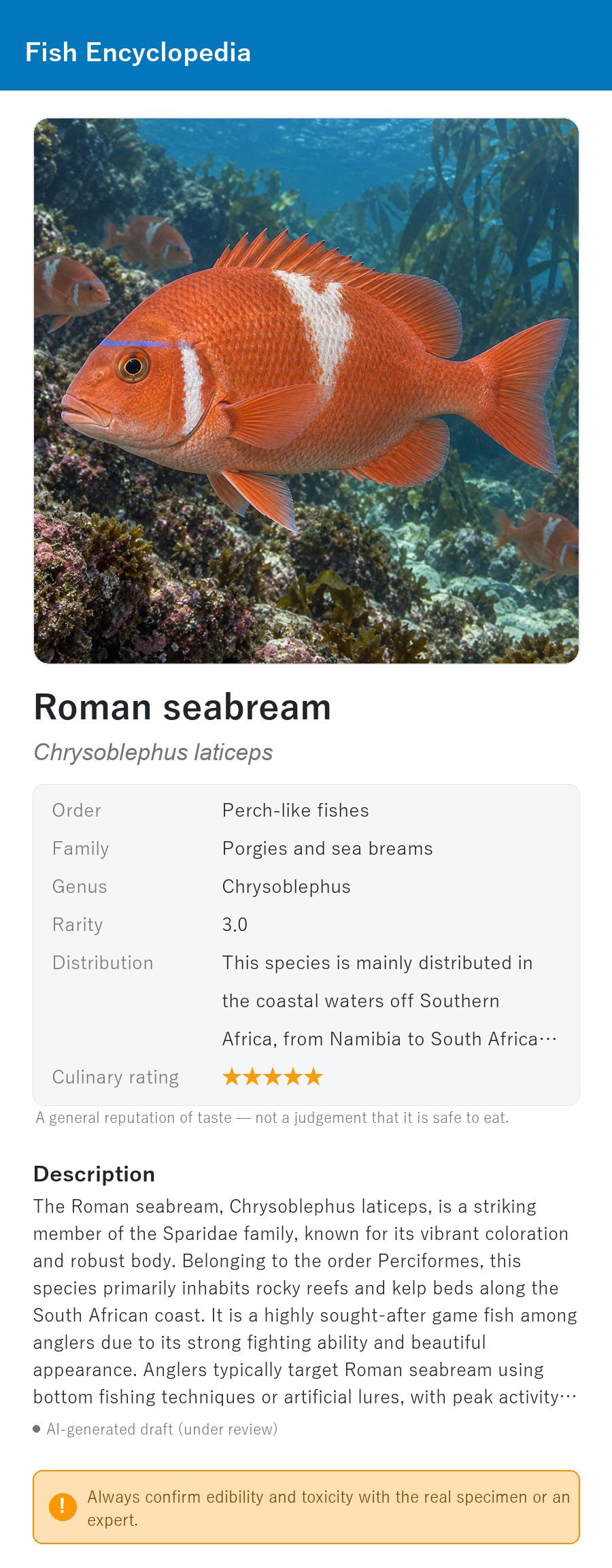
アプリの魚図鑑での表示イメージ。日本語・英語どちらの表示にも対応しています。イラストは左右にスワイプ(Web版はイラスト下の左右ボタン)で白背景版と切り替えられます。生息イメージ版がまだ用意できていない種は、これまでどおり白背景版の1枚だけを表示します。
今回は「その科の残り38〜49種」
図鑑は「目 → 科 → 属 → 種」とたどれます。前回までに「あと34種以内で揃う科」をすべて埋めたので、今回は「あと38〜49種で、その科の全種が2枚立てになる」4つの科をまとめて描きました。タイ科・メバル科・アジ科・ハタ科です。
このうちハタ科は全種がそろいました。メバル科とアジ科も、図鑑の中で同じ種が別の学名で二重に載っているなど「整理が必要な行」を除いて、すべての種で2枚のイラストが切り替わります。タイ科は、後で書く描き直しの1種だけが残っています。残り種数がいちばん多いハゼ科は、今回も9つの属をまるごと描きました。
南アフリカと地中海のタイ科
タイの仲間は36種。日本のマダイやクロダイの親戚ですが、今回は南アフリカ、地中海、アラビア海の固有種が中心です。南アフリカの Chrysoblephus 属4種は、背中の白い鞍形の斑(Roman seabream)、眼の上下の短い青い線と背びれの後ろの黒点(Dageraad)、大きな雄の額のこぶ(Red stumpnose)、模様の無い青みのピンク(Slinger seabream)で描き分けています。タイ科最大の「Red steenbras」は大きな口と太い犬歯、「Musselcracker seabream」は貝を砕く厚い唇と強い前歯。地中海では、とがって突き出す吻の「Sharpsnout seabream」、暗い赤の帯が並ぶマルダイなど。砂浜の波打ち際、ケルプの林、河口の濁った水と、産地の海も描き分けました。
浅いケルプと深場の岩礁のメバル
メバル・メヌケの仲間は39種、多くが北米の太平洋岸と北日本の海の魚です。この仲間は浅いケルプの森にすむ種と、水深100mより深い岩場にすむ種が混じるので、種ごとに水深を指定し、深場の種は薄暗い深い青で描いています(釣り上げられた姿ではなく、水中の自然な姿です)。黒地に黄色い帯が1本走る「China rockfish」、緑の線が4本の「Greenstriped rockfish」、斜めの赤褐色の帯の「Calico rockfish」、尾びれの付け根に白い帯があるコウライヨロイメバル、受け口でえらぶたに黒い帯が入るウケグチメバル、尾びれの後ろの縁が白いエゾメバル、水深500m以深の真っ赤なホウズキ。泥の上に胸びれで座るアラスカキチジも入りました。
銀色の似た種が並ぶアジ科
アジの仲間は40種。銀色で似た姿の種が多いので、体の高さ・額の形・えらぶたの黒い斑・ひれの色、そして産地の海で描き分けました。口の中が真っ白に見えるオキアジと「Cottonmouth Jack」(見た目はほぼ同じなので、日本の沖の砂底とカリブ海の島の周りで描き分け)、雄の背びれと臀びれが房のように伸びる「Fringefin Trevally」、背びれの先が鞭のように伸びるテンジクアジ、大きな黒い腹びれを腹の溝にたたむクボアジ、眼の大きなテルメアジ、燕尾のような尾をもつ豪州の「Dart」など。
礁と深場のハタ科
ハタの仲間は49種で、これでハタ科は全種がそろいました。褐色の斑点をもつ似たハタが多いので、斑点の大きさ・色・密度、帯の本数をメモで細かく指定しています。眼の後ろから白い帯が矢筈(Y字)の形に上がるヤハズアオハタと、その白い帯をもたないコクテンアオハタ、背びれの2本目の棘だけが長く伸びるヒレナガハタ、九州―パラオ海嶺の海山で1個体だけ知られる「seamount grouper」、茶と灰の帯が交互に並ぶ「Greybanded Grouper」。水深100〜300mの砂泥底にすむ小型のヒメコダイの仲間7種は、えらぶたの赤い眼状斑(トサヒメコダイ)、体の中ほどに並ぶ黒い斑(ホシヒメコダイ)、吻の小さな黒い点(「Pogi Perchlet」)などで見分けます。
ハゼは「属ごと」まとめて
ハゼの仲間は36種で、9つの属を完結させました。サンゴ礁の1.5〜4cmの小さなハゼ(イソハゼ・ベニハゼの仲間)は、色と斑の位置だけが種を分けるので、寄った構図で描いています。枝サンゴの上にホバリングするシロオビイソハゼやオヨギイソハゼ、灯台のような紅白の縞のスジシマイソハゼ、青灰色のジグザグ線のアオベニハゼ。潮だまりのクモハゼの仲間は、頭の形(丸顔のヤハズハゼと面長のクサビハゼ)と白い鞍形の斑で、マングローブのムジナハゼの仲間は市松模様で見分けます。鱗の無い緑の体に赤いひれのアカヒレハダカハゼは、波しぶきのかかる小さな潮だまりに描きました。
メモの誤りを、描き手が資料で見つけてくれました
イラストは「この種はここが決め手」というメモを付けて依頼しています。今回も依頼する前にメモを図鑑や魚類データベース、元の記載論文と突き合わせ、30か所を直してから発注しました(ヤハズアオハタの白い帯の位置もその1つです)。
それでも1か所、メモが間違っていました。台湾の河口にすむ「Taiwan seabream」を、メモでは「頭と体の大部分が黒い」と書いていましたが、描き手が資料を引き直して「生きているときは銀色がかった体」だと気づき、資料のほうに合わせて描いて報告してくれました。こちらでも同じ資料を確かめ、そのとおりだったので採用しています。依頼書には「メモと資料が食い違ったら資料を優先し、報告する」と書いており、その取り決めが働いた例です。
1種だけ描き直しをお願いしています
寸法やファイル名の機械的なチェックとは別に、納品されたイラスト200点すべてを1枚ずつ目で見て種を照合する工程を今回も行い、気になった約40点は原寸で見直しました。そのうち紅海の「Haffara seabream」1種は、本来は「側線の始まり」と「胸びれの付け根」にしか無い黒い斑が、胴の真ん中にも描かれていたため、今回は掲載せずに描き直しをお願いしています。この種は白背景版のイラストで引き続きご覧いただけます。間違った絵は掲載しない方針は変わりません。お気づきの点があれば、ぜひアプリの「バグ報告」からお知らせください。
ご注意
- 図鑑の絵は写真ではなくイラストです。 生息イメージ版は水中での見え方を伝えるために描いたもので、特定の個体や実際の撮影地を記録したものではありません。
- 毒の有無や種の判断は、必ず実物と専門家の確認をお願いします。 図鑑の表示は参考情報であり、安全を保証するものではありません。
- 解説の一部は AI による下書きで、順次見直しを進めています。お気づきの点はアプリの「バグ報告」からお知らせください。
- 名称・分類データは GBIF を出典としています。図鑑のイラストの著作権は世界釣りマップに帰属します。無断転載・二次利用はご遠慮ください。
Encyclopedia illustrations come in two versions — a plain one and an in-habitat one. Following the previous 200 species, another 199 now have both versions, for a total of 2,689 species. No species were added; the encyclopedia still covers about 2,939.
How species look in the app encyclopedia — available in both Japanese and English. Swipe the illustration left or right to switch versions (on the web, use the arrow buttons below it). Species without in-habitat artwork simply show the single plain illustration, exactly as before.
This time: families 38 to 49 species short
The encyclopedia is browsable by order, family, genus and species. Having already filled every family that was 34 or fewer species short, this time we took on the four families that were 38 to 49 species short of complete coverage: the sea breams, rockfishes, jacks, and groupers.
The groupers are now complete. The rockfishes and jacks are complete too, apart from a few entries that need tidying up in the encyclopedia (for example, the same species listed twice under different scientific names). The sea breams have just one species left — the redraw described below. For the gobies, still the family with the most to go, we again completed nine whole genera.
Sea breams of South Africa and the Mediterranean
Thirty-six sea breams, relatives of Japan's red and black sea breams, mostly endemics of South Africa, the Mediterranean and the Arabian Sea. Four South African Chrysoblephus are told apart by a white saddle on the back (Roman seabream), short blue lines above and below the eye with a black dot at the end of the dorsal fin (Dageraad), the forehead hump of large males (Red stumpnose), and plain bluish pink (Slinger seabream). The Red steenbras, the largest sea bream of all, has a big mouth and stout canines; the Musselcracker seabream has thick lips and strong front teeth for crushing shellfish. From the Mediterranean come the Sharpsnout seabream with its protruding pointed snout and the Red-banded Sea Bream with its dark red bars. Surf beaches, kelp forests and murky estuaries are each set in their own home waters.
Rockfishes of shallow kelp and deep reefs
Thirty-nine rockfishes, mostly from the Pacific coast of North America and northern Japan. This group mixes kelp-forest species with species of rocky reefs below 100 m, so we specified the depth for each; deep-water species are drawn in dim, deep blue (and as they look underwater, not as they look when hauled up). The China rockfish with a single yellow stripe on black, the Greenstriped rockfish with four green lines, the Calico rockfish with slanting red-brown bars, Sebastes longispinis with a white band across the base of the tail, the underbite Sagami rockfish with a black bar on the gill cover, the White-edged rockfish with a white rear edge to the tail, and the all-red Emblem rockfish from below 500 m. The Shortspine thornyhead, which sits on mud propped up on its pectoral fins, is here too.
Jacks: silvery look-alikes
Forty jacks. Many are similar silvery fish, so we told them apart by body depth, forehead shape, the dark spot on the gill cover and fin colour, and by the waters they come from. The Whitemouth Jack and Cottonmouth Jack, both with a strikingly white mouth, look almost identical, so one is set on a sandy bottom off Japan and the other around a Caribbean island. Also the Fringefin Trevally, whose males grow tassel-like dorsal and anal fins; the coachwhip trevally with a whip-like dorsal filament; the cleftbelly trevally that folds its big black pelvic fins into a groove on the belly; the big-eyed Ox-eye Scad; and Australia's Dart with its swallow-like tail.
Groupers of reefs and deep water
Forty-nine groupers — and with them, every grouper in the encyclopedia now has both illustrations. Many look alike with brown spots, so our notes spelled out the size, colour and density of the spots and the number of bars. The Bighead Grouper, with a white band rising behind the eye and forking into a Y, versus the Fivebar Grouper, which has no such band; the Marquesan Grouper with only its second dorsal spine drawn out long; the seamount grouper, known from a single fish from a seamount on the Kyushu–Palau Ridge; and the Greybanded Grouper with alternating brown and grey bars. Seven small perchlets of sandy-mud bottoms at 100–300 m are told apart by a red eyespot on the gill cover (Chelidoperca tosaensis), a row of black spots along the side (C. pleurospilus), and tiny black dots on the snout (Pogi Perchlet).
Gobies, one whole genus at a time
Thirty-six gobies, completing nine genera. The tiny coral-reef dwarfgobies and pygmygobies (1.5–4 cm) differ only in colour and where their spots sit, so they are drawn close up: the Blackbelly Dwarfgoby and Doublebar Goby hovering above branching coral, the Lighthouse Atom Goby with red-and-white bands, and the Meander Dwarfgoby with its blue-grey zigzag lines. The frillgobies of tide pools are told apart by head shape (the round-faced Cyclops Frillgoby and the wedge-headed Cheekscaled Frill-goby) and white saddles; the mangrove gobies by their checkerboard patterns. The scaleless, green-bodied Cardinal Goby with its red fins is drawn in a tiny spray-splashed tide pool.
The illustrator caught a mistake in our notes
Each illustration is commissioned with a short note on what identifies the species. Again this time we checked the notes against field guides, fish databases and original descriptions before ordering, and corrected 30 points (the position of the Bighead Grouper's white band was one of them).
Even so, one note was wrong. We had described the Taiwan seabream, a fish of Taiwanese estuaries, as "mostly black on the head and body". The illustrator went back to the sources, found that the live fish is silvery, drew it that way, and reported the discrepancy. We checked the same sources, confirmed it, and accepted the drawing. Our brief says "if the note and the sources disagree, follow the sources and tell us" — and that is exactly what happened.
One species sent back for a redraw
Alongside the mechanical checks on dimensions and file naming, we again reviewed all 200 delivered illustrations one by one and verified each species, taking a full-size second look at about 40 of them. One — the Haffara seabream of the Red Sea — had a black spot drawn in the middle of its body, where the real fish has none (its only dark spots are at the start of the lateral line and at the base of the pectoral fin). We have not published it and have asked for a redraw; until then it keeps its plain illustration. Our policy of never publishing incorrect artwork is unchanged. If you spot something, please tell us through "Report a bug" in the app.
Notes
- These are illustrations, not photographs. The in-habitat version is drawn to convey how a species looks underwater; it does not record a particular individual or a real location.
- Always confirm identification and venomousness with the real specimen and an expert. Entries in the encyclopedia are reference information and are not a guarantee of safety.
- Some descriptions are AI-generated drafts that we are reviewing over time. If you spot an error, please tell us through "Report a bug" in the app.
- Names and taxonomy are sourced from GBIF. The encyclopedia illustrations are © World Fishing Map; please do not reproduce or reuse them without permission.