
「生息イメージ」のイラストをさらに196種へ追加しました(合計2,290種)
魚図鑑のイラストは、種によって「白背景版」と「生息イメージ版」の2枚を用意しています。前回の199種に続いて、今回はさらに196種が2枚立てになり、合計2,290種になりました。収録種数は約2,939種のままで、種の追加はありません。
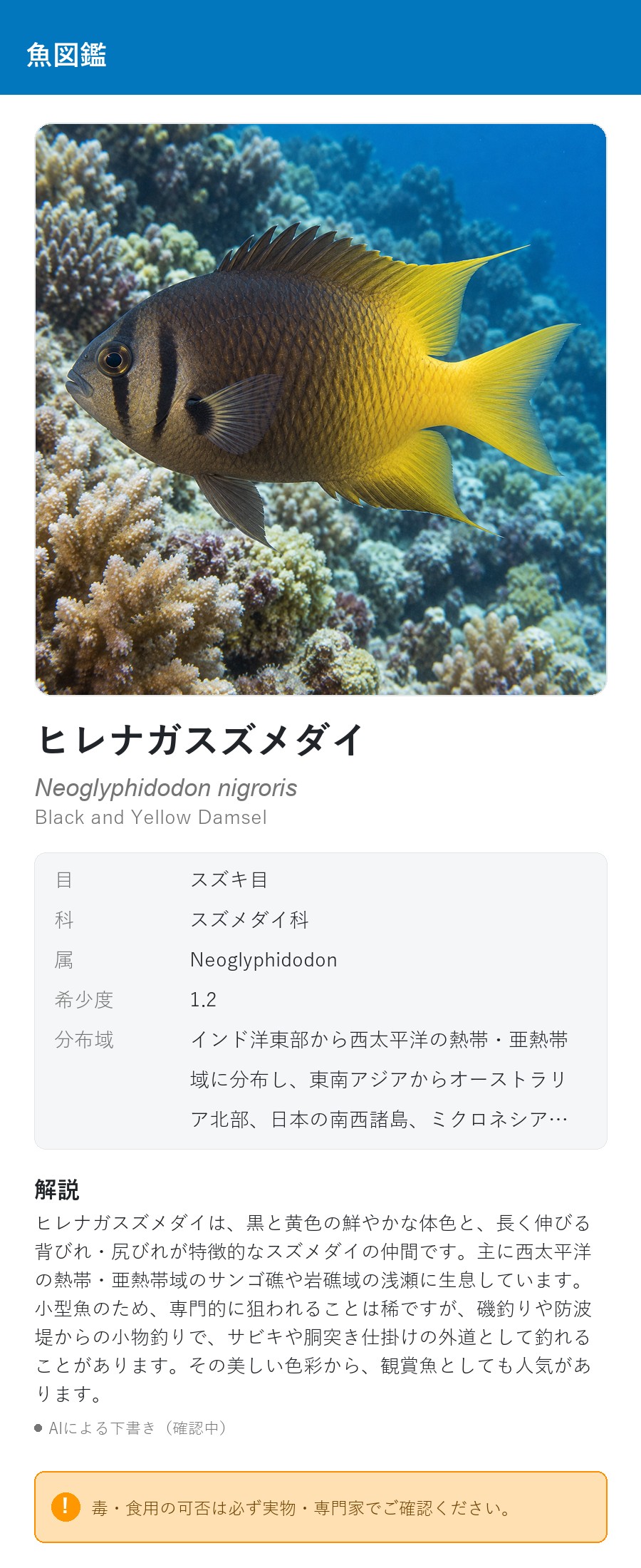
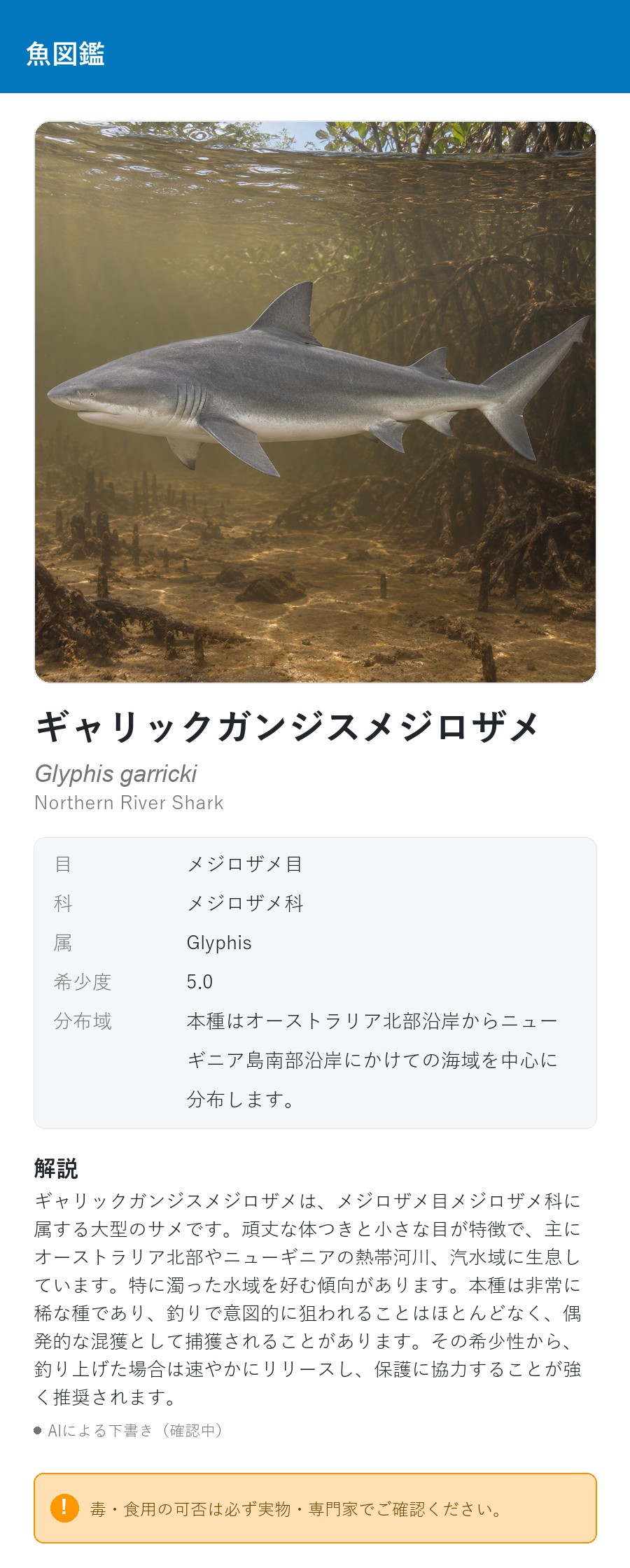
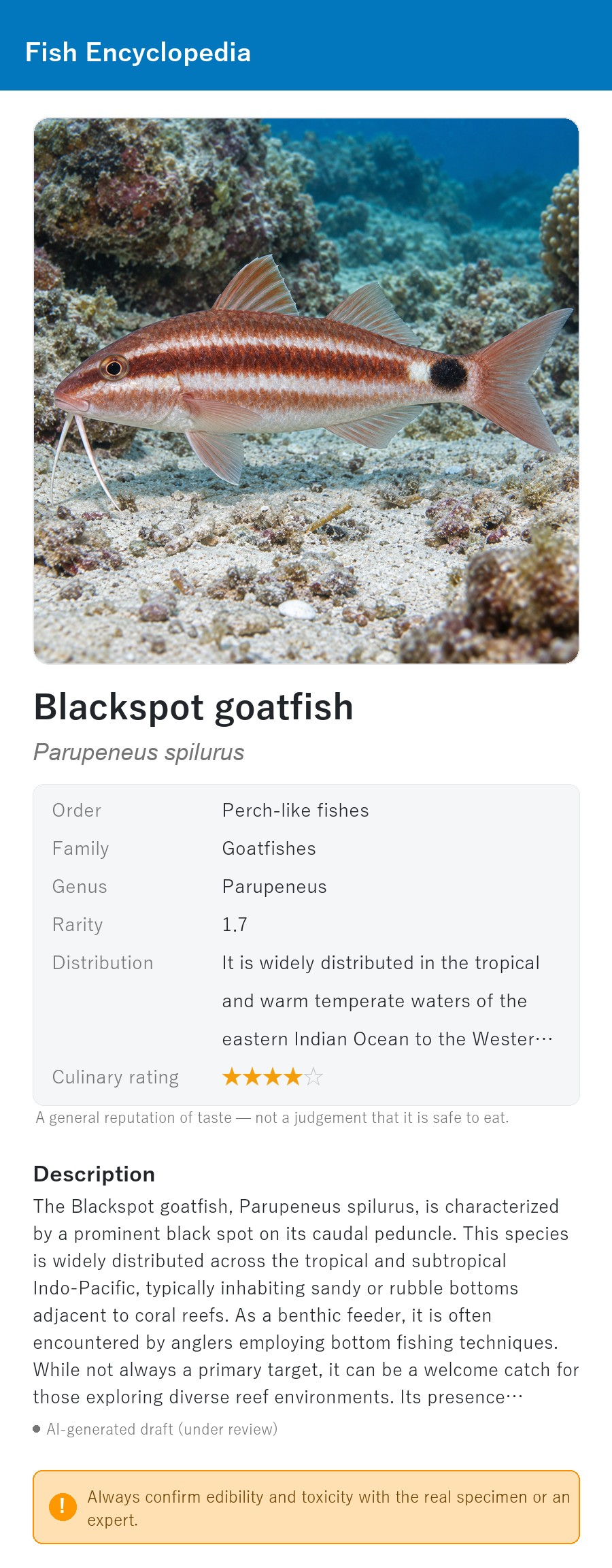
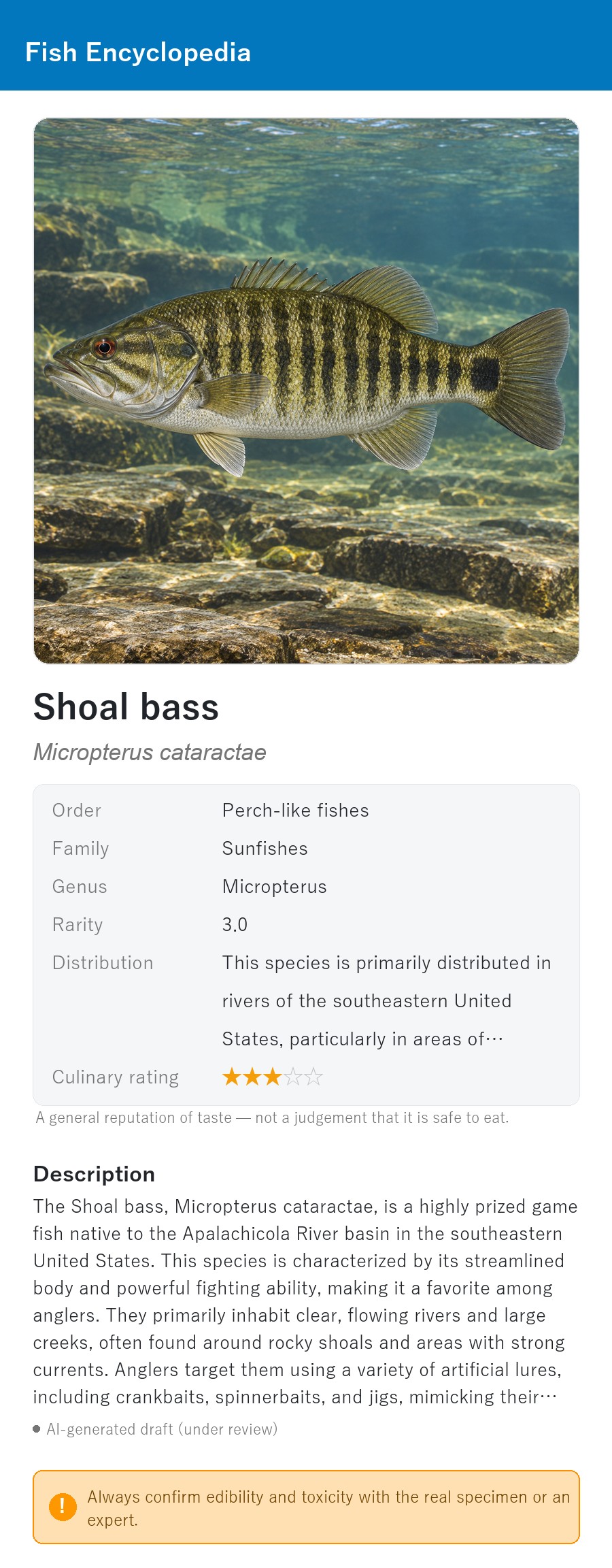
アプリの魚図鑑での表示イメージ。日本語・英語どちらの表示にも対応しています。イラストは左右にスワイプ(Web版はイラスト下の左右ボタン)で白背景版と切り替えられます。生息イメージ版がまだ用意できていない種は、これまでどおり白背景版の1枚だけを表示します。
今回は「その科の残り13〜29種」
図鑑は「目 → 科 → 属 → 種」とたどれます。前回までに「あと12種以内で揃う科」をすべて埋めたので、今回は「あと13種から29種で、その科の全種が2枚立てになる」9つの科をまとめて描きました。メジロザメ科・スズメダイ科・サバ科・イサキ科・フエフキダイ科・サンフィッシュ科・ニザダイ科・チョウチョウウオ科・ニベ科です。
このうちメジロザメ科・スズメダイ科・イサキ科・フエフキダイ科・ニザダイ科と、前回の描き直しが届いたヒメジ科の6つの科は、科のページを開けばすべての種で2枚のイラストが切り替わるようになりました。サンフィッシュ科とニベ科は、有効な種として確認できない学名の行(整理予定)が1つずつ残っているため、それを除いて揃っています。サバ科とチョウチョウウオ科は、下に書く描き直し待ちの2種ずつを残すだけです。
サメは「どのひれの先が黒いか」
豪州北部とアジアの沿岸・河口にすむ小型のメジロザメの仲間13種。この仲間は、体の形がよく似ていて、どのひれの先が黒いかで種が分かれます。第2背びれの先だけが黒い「Australian Blackspot Shark」と「blackspot shark」(外見ではほぼ見分けられないので、豪州北部とアジアの海で描き分け)、背びれや尾びれに細い黒い縁取りだけが入る「Nervous Shark」、黒い斑をもたない「Creek Whaler Shark」とホコサキ、吻がこてのように平たいボルネオトガリアンコウザメ、眼の後ろに切れ込みのあるトガリザメ、そして濁った大河の感潮域にすむギャリックガンジスメジロザメ。黒い斑のある・なしは13種すべてで確認しました。
サンゴ礁の常連たち
スズメダイの仲間は14種。カリブ海の「Atlantic Sergeant Major」と、尾びれにハサミの刃のような黒い線が入るロクセンスズメダイ、全身レモン色のネッタイスズメダイ、頭が青く後ろへ黄色くなるレモンスズメダイ、マングローブの小川にすむリボンスズメダイ、豪州南岸のコンブの林にすむ大型の「Scalyfin」、ブラジルの岩場の2種。幼魚と成魚で色が大きく変わる種が多いので、すべて成魚の姿で描いています。コショウダイ・イサキの仲間は18種(黄色い線のニジコショウダイ、黒い点と黄色いひれの「Blackspotted rubberlip」、体の上3分の2にだけ黒い線が入るヒレグロコショウダイ、えらぶたの縁が赤い「Minstrel sweetlips」、砂泥底のミゾイサキの仲間6種など)。フエフキダイの仲間は20種で、赤い差し色の位置が決め手です(すべてのひれが赤い「Longfin emperor」、えらぶたの上に赤い斑が1つのホオアカクチビ、体の後ろに細長い黒斑のアミフエフキ、2013年に記載されたタマメイチとヒキマユメイチの「眉」など)。
サバの仲間は「点か、線か、帯か」
サバの仲間は12種。サワラの仲間は体の模様で種が分かれます。短い線が並ぶ「Streaked seerfish」、途切れ途切れの長い線の「Kanadi kingfish」、丸い点の豪州の「Australian seerfish(Spotted mackerel)」、ぼやけた大きな斑の「School mackerel」、背側にだけ太い帯が入る「Grey mackerel」、橙色の点が並ぶ東太平洋の「Pacific sierra」。ほかに、側線が2本あるニジョウサバ、体高の高い「Short mackerel」、跳ねるカツオ「Leaping bonito」、豪州のハガツオ、大西洋のサバ2種(腹が無地の「Atlantic mackerel」と、腹にぼやけた斑のある「Atlantic chub mackerel」)が入りました。
北米の川のバスとサンフィッシュ
サンフィッシュの仲間は20種、すべて淡水です。ブラックバスの仲間は、2013年に1種から分けられた「Redeye bass」の一群が見どころ。元の記載論文にさかのぼると、ひれの色がはっきり違います(れんが色の「Redeye bass」、赤みのない緑の「Cahaba bass」「Tallapoosa bass」、尾に幅広い白い縁の「Warrior bass」、鮮やかな橙色の「Chattahoochee bass」)。虎じまの「Shoal bass」、雄の頬と腹がターコイズ色になるフロリダの「Suwannee bass」、テキサスの「Guadalupe bass」、コクチバスの亜種ネオショスモールマウスバスも。小さなサンフィッシュは、えらぶたの黒い「耳」の形と色で見分けます(細長く真っ黒な「Redbreast」、斜め上を向く「Northern」、赤い点の「Redspotted」と黒い点の「Spotted」、科で最小級の「Bantam」)。
尾の付け根に刃を持つニザダイ科
ニザダイの仲間は26種。テングハギの仲間は角とこぶで、クロハギの仲間は眼の後ろの印で種が分かれます。口より前へ長い角が突き出るヒメテングハギ、角の下の吻が極端に短いツマリテングハギ、背にこぶのあるオニテングハギ、吻の前が丸くふくらむトサカハギ、角をもたないテングハギモドキ、マグロのように細長いボウズハギ。眼の後ろに丸い黒斑のカンランハギ、細長い黒い帯のクロモンツキ、白い帯2本と白い点のゴマニザ、黒い体に白い尾のメガネクロハギ。尾の付け根の刃(骨質板)は、ボウズハギだけが1つ、豪州の「Spotted Sawtail」は3つ、「Australian Sawtail」は6つ前後——数も1枚ずつ確認しました。
模様そのものが種、チョウチョウウオ科
チョウチョウウオの仲間は27種。青く縁取られた黒い丸のウミヅキチョウチョウウオ、縁取りのない黒い楕円のトノサマダイ、青い細長い斑のスミツキトノサマダイ、涙のしずくのような黒斑のイッテンチョウチョウウオ。眼の黒い帯が額までつながるニセフウライチョウチョウウオと、途切れて額に黒い点が独立するヒメフウライチョウチョウウオ。「く」の字の線のミカドチョウチョウウオ・ヤリカタギ・ベニオチョウチョウウオ、黒い体に白い点のハクテンカタギ、角のあるツノハタタテダイ、内湾の海草帯のテンツキチョウチョウウオ、豪州南西岸の冷たい岩礁の「Southern Butterflyfish」などです。
濁った河口の銀色の魚、ニベ科
ニベの仲間は28種。見た目が似た銀色の魚が多いので、下あごのヒゲ(1本/小さなヒゲの列/なし)や尾びれの形、ひれの色を確かめながら描いています。北米の大河の「Freshwater drum」と、アマゾンの「South American silver croaker」は淡水の魚。南アフリカの「Silver kob」、マダガスカルの「Madagascar kob」、口の中が黄色い「African weakfish」(現地名 Geelbek)、地中海の「Brown Meagre」と「Shi drum」、小さな黒い点のゴマニベ、北米東岸の「Weakfish」など Cynoscion 属7種も入りました。
ハゼも積み増し
残り種数がいちばん多いハゼの仲間からも17種。テッポウエビと巣穴を分け合う共生ハゼ(槍の穂先のような尾のヤジリハゼ、背びれが羽衣のように伸びるハゴロモハゼ、クロオビハゼ・オビシノビハゼ・ヒメシノビハゼ・シマオリハゼ)、ハナヤサイサンゴの枝にすむヨゴレダルマハゼ、貝殻や空き瓶の中にすむイレズミミジンベニハゼ、洞窟の壁のベニハゼ、青い点がきらめくヒメホシハゼなどです。
前回の描き直しが届きました
前回、同じ仲間の有名な魚「オジサン」の模様(背から腹への帯)で届いたため描き直しにしていたオキナヒメジ(Parupeneus spilurus)が、今回は本来の頭から尾へ走る帯と尾の付け根の大きな黒い斑で届きました。これでヒメジ科15種が全種そろいました。
描いてもらう前の検算も続けています
イラストは「この種はここが決め手」というメモを付けて依頼しています。学名や分布はデータベースから自動で入るので、間違いが残るとすればこの手書きのメモです。前回に続いて依頼する前にメモを図鑑や魚類データベースの記載と突き合わせ、約60種のメモを直しました。たとえば上の「Redeye bass」の一群は、最初は「見た目では区別できないので背景で描き分ける」としていましたが、元の論文にさかのぼるとひれの色に絵にできる違いがありました。直したメモは、直したとおりに描かれて届いています。
全点を目視で確認、4種は描き直しへ
寸法やファイル名の機械的なチェックとは別に、納品されたイラスト200点すべてを1枚ずつ目で見て種を照合する工程を今回も行いました。その結果、196点が合格、4点を描き直しにしています。
- ウシサワラ:この種を見分ける決め手の「第1背びれの下で急に折れ曲がる側線」が描かれておらず、ほかのサワラと区別できない絵になっていました。
- ニシアフリカサワラ:体の斑は背から腹の方向にやや細長い楕円が3列ほどですが、頭から尾の方向に細長い破線のような斑で描かれていました。
- オニハタタテダイ・シマハタタテダイ:背びれの白い「旗」が、有名なハタタテダイのように尾びれより後ろまで長く描かれていました。この2種の成魚の旗はもっと短いのが特徴です。
間違った絵は掲載していません。この4種は描き直しが届くまで、白背景版の1枚だけを表示します。お気づきの点があれば、ぜひアプリの「バグ報告」からお知らせください。
ご注意
- 図鑑の絵は写真ではなくイラストです。 生息イメージ版は水中での見え方を伝えるために描いたもので、特定の個体や実際の撮影地を記録したものではありません。
- 毒の有無や種の判断は、必ず実物と専門家の確認をお願いします。 図鑑の表示は参考情報であり、安全を保証するものではありません。
- 解説の一部は AI による下書きで、順次見直しを進めています。お気づきの点はアプリの「バグ報告」からお知らせください。
- 名称・分類データは GBIF を出典としています。図鑑のイラストの著作権は世界釣りマップに帰属します。無断転載・二次利用はご遠慮ください。
Encyclopedia illustrations come in two versions — a plain one and an in-habitat one. Following the previous 199 species, another 196 now have both versions, for a total of 2,290 species. No species were added; the encyclopedia still covers about 2,939.
How species look in the app encyclopedia — available in both Japanese and English. Swipe the illustration left or right to switch versions (on the web, use the arrow buttons below it). Species without in-habitat artwork simply show the single plain illustration, exactly as before.
This time: families 13 to 29 species short
The encyclopedia is browsable by order, family, genus and species. Having already filled every family that was twelve or fewer species short, this time we took on the nine families that were 13 to 29 species short of complete coverage: the requiem sharks, damselfishes, mackerels, grunts and sweetlips, emperors, North American sunfishes and basses, surgeonfishes, butterflyfishes, and drums and croakers.
In six families — the requiem sharks, damselfishes, grunts, emperors and surgeonfishes, plus the goatfishes now that last time's redraw has arrived — every species now switches between both illustrations. The sunfishes and the drums each still have one leftover row whose scientific name we could not confirm as a valid species (to be cleaned up), and the mackerels and butterflyfishes are two species short each — see below.
Sharks: which fin tips are black
Thirteen requiem sharks from the coasts and river mouths of northern Australia and Asia. They look much alike, and which fin tips are black is what separates the species: the Australian blackspot and blackspot sharks with only the second dorsal tipped black (nearly identical, so we set them in Australian and Asian waters), the Nervous shark with only thin black edges, the Creek whaler and Hardnose sharks with no black at all, the spade-snouted New spadenose shark, the Sliteye shark, and the Northern river shark of big muddy tidal rivers. We checked the fin markings on all thirteen.
Reef regulars
Fourteen damselfishes: the Atlantic sergeant major and the Scissortail sergeant with its scissor-blade tail stripes, the all-yellow Lemon damsel, the King damselfish that fades from a blue head to a yellow tail, the Freshwater damselfish of mangrove creeks, the large Scalyfin of southern Australian kelp, and two from Brazilian rocky shores — all drawn as adults, since many change colour dramatically as they grow. Eighteen grunts and sweetlips, including Celebes sweetlips with yellow stripes, Blackspotted rubberlip, Lesson's thicklip striped only on its upper two-thirds, the red-gilled Minstrel sweetlips and six sand-bottom grunters. Twenty emperors, where the placement of red is the key: the Longfin emperor with every fin red, the Spotcheek emperor with a single red mark on the gill cover, the Black blotch emperor, and two large-eye breams described only in 2013, each with a dark "eyebrow".
Mackerels: dots, dashes or bars
Twelve mackerels. Spanish mackerels are told apart by their side markings: short streaks on the Streaked seerfish, broken lines on the Kanadi kingfish, round spots on the Australian spotted mackerel, a few blurry blotches on the School mackerel, bars on the upper half only on the Grey mackerel, and orange spots on the Pacific sierra. Also the Double-lined mackerel with two lateral lines, the deep-bodied Short mackerel, the Leaping bonito, the Australian bonito, and both Atlantic mackerels — the Atlantic mackerel with a plain belly and the Atlantic chub mackerel with a spotted one.
Basses and sunfishes of North American rivers
Twenty sunfishes and black basses, all freshwater. The highlight is the Redeye bass group, split into several species in 2013: going back to the original descriptions, their fin colours clearly differ — brick-red in the Redeye bass, green without any red in the Cahaba and Tallapoosa basses, a broad white tail edge in the Warrior bass and bright orange in the Chattahoochee bass. Also the tiger-striped Shoal bass, the Suwannee bass whose males turn turquoise, the Guadalupe bass of Texas and the Neosho smallmouth bass. The small sunfishes are told apart by the black "ear" flap on the gill cover: long and all black in the Redbreast, angled upward in the Northern, with red dots in the Redspotted and black dots in the Spotted sunfish, and the tiny Bantam sunfish.
Surgeonfishes, with a blade at the tail
Twenty-six surgeonfishes. Unicornfishes are told apart by their horns and humps, and the Acanthurus species by the mark behind the eye: the long-horned White margin unicornfish, the Spotted unicornfish with a very short snout under its horn, the humpbacked Humpback unicorn, the bulb-nosed Bluntnose unicornfish, the hornless Sleek unicornfish and the tuna-shaped Barred unicornfish; the Bariene surgeonfish with a round black spot behind the eye, the Epaulette surgeonfish with a black bar, the Whitespotted surgeonfish with two white bands, and the black-bodied, white-tailed Black surgeonfish. We also counted the blades on the tail base: one on the Barred unicornfish, three on the Spotted sawtail and about six on the Australian sawtail.
Butterflyfishes, where the pattern is the species
Twenty-seven butterflyfishes: the Archer butterflyfish with its blue-ringed black spot, the Mirror butterflyfish with a plain black oval, the Blue-blotched butterflyfish, and the Limespot butterflyfish with its teardrop mark; the Line butterflyfish, whose eye bar runs up over the forehead, and the Pig-face butterflyfish, whose eye bar breaks off beneath a separate forehead spot; chevron-marked Eastern triangle, Chevron and Atoll butterflyfishes; the dark Black butterflyfish with pale dots; the horned Horned bannerfish; the Eye-spot butterflyfish of seagrass bays; and the Southern butterflyfish from the cold rocky reefs of southwestern Australia.
Drums and croakers of muddy river mouths
Twenty-eight drums and croakers. Many are similar silvery fish, so we checked the chin barbels (one, a small row, or none), tail shape and fin colours on each. The Freshwater drum of North America's big rivers and the South American silver croaker of the Amazon live in fresh water. Also the Silver kob of South Africa, the Madagascar kob, the yellow-mouthed African weakfish (Geelbek), the Brown meagre and Shi drum of the Mediterranean, the Blackspotted croaker, and seven Cynoscion weakfishes including the Weakfish of the US East Coast.
More gobies
Seventeen more gobies from the largest remaining group: shrimpgobies that share a burrow with snapping shrimp (the spear-tailed Lanceolate shrimpgoby, the sail-finned Bigmouth shrimpgoby, and others), the Redhead goby of Pocillopora corals, the Golden goby that lives inside shells and bottles, the Caesiura pygmygoby of cave walls and the blue-speckled Rubble goby.
Last time's redraw has arrived
The Blackspot goatfish (Parupeneus spilurus), sent back last time because it came with the vertical bars of its famous relative the Manybar goatfish, has now arrived with its own head-to-tail stripes and large black spot on the tail base. All 15 goatfishes now have both illustrations.
We keep checking the brief before ordering
Each illustration is commissioned with a short note on what identifies the species. Names and ranges come straight from the database, so any remaining mistakes live in those hand-written notes. As last time, we checked the notes against published descriptions before ordering and corrected about 60 of them. For example, we had first written that the Redeye bass group could only be told apart by setting, but the original descriptions show fin colours that can be drawn. The corrected notes came back drawn as corrected.
Every illustration checked by eye — four sent back
Alongside the mechanical checks on dimensions and file naming, we again reviewed all 200 delivered illustrations one by one and verified each species. 196 passed and four are being redrawn:
- Chinese seerfish: its key feature, a lateral line that bends sharply downward below the first dorsal fin, was missing, leaving it indistinguishable from other Spanish mackerels.
- West African Spanish mackerel: its spots should be slightly taller than long, in about three rows, but they were drawn as dashes running head to tail.
- Masked bannerfish (Heniochus monoceros) and Singular bannerfish (H. singularius): both came with a long white dorsal banner trailing past the tail, like the well-known Pennant coralfish (H. acuminatus). Adults of these two have a much shorter one.
The incorrect artwork was not published; these four species show only their plain illustration until the redraws arrive. If you spot something, please tell us through "Report a bug" in the app.
Notes
- These are illustrations, not photographs. The in-habitat version is drawn to convey how a species looks underwater; it does not record a particular individual or a real location.
- Always confirm identification and venomousness with the real specimen and an expert. Entries in the encyclopedia are reference information and are not a guarantee of safety.
- Some descriptions are AI-generated drafts that we are reviewing over time. If you spot an error, please tell us through "Report a bug" in the app.
- Names and taxonomy are sourced from GBIF. The encyclopedia illustrations are © World Fishing Map; please do not reproduce or reuse them without permission.