
「生息イメージ」のイラストをさらに199種へ追加しました(合計2,094種)
魚図鑑のイラストは、種によって「白背景版」と「生息イメージ版」の2枚を用意しています。前回の200種に続いて、今回はさらに199種が2枚立てになり、合計2,094種になりました。収録種数は約2,939種のままで、種の追加はありません。
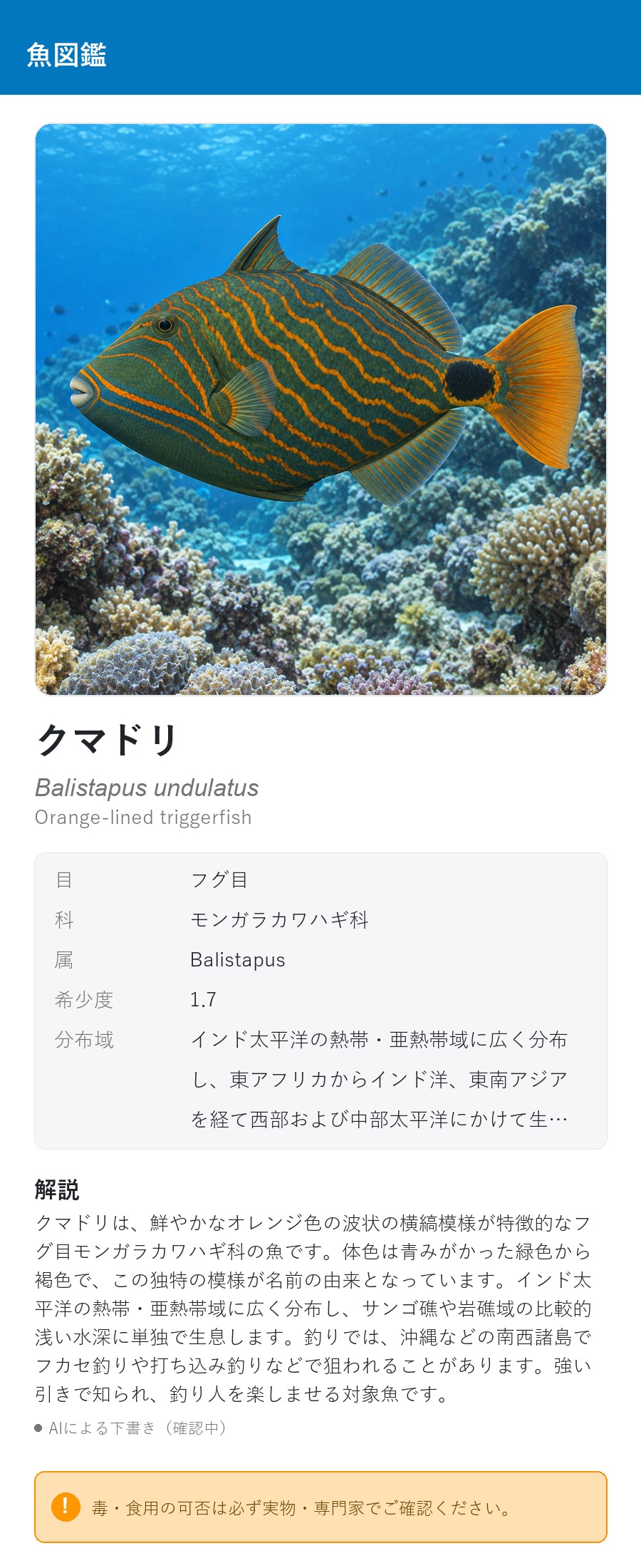
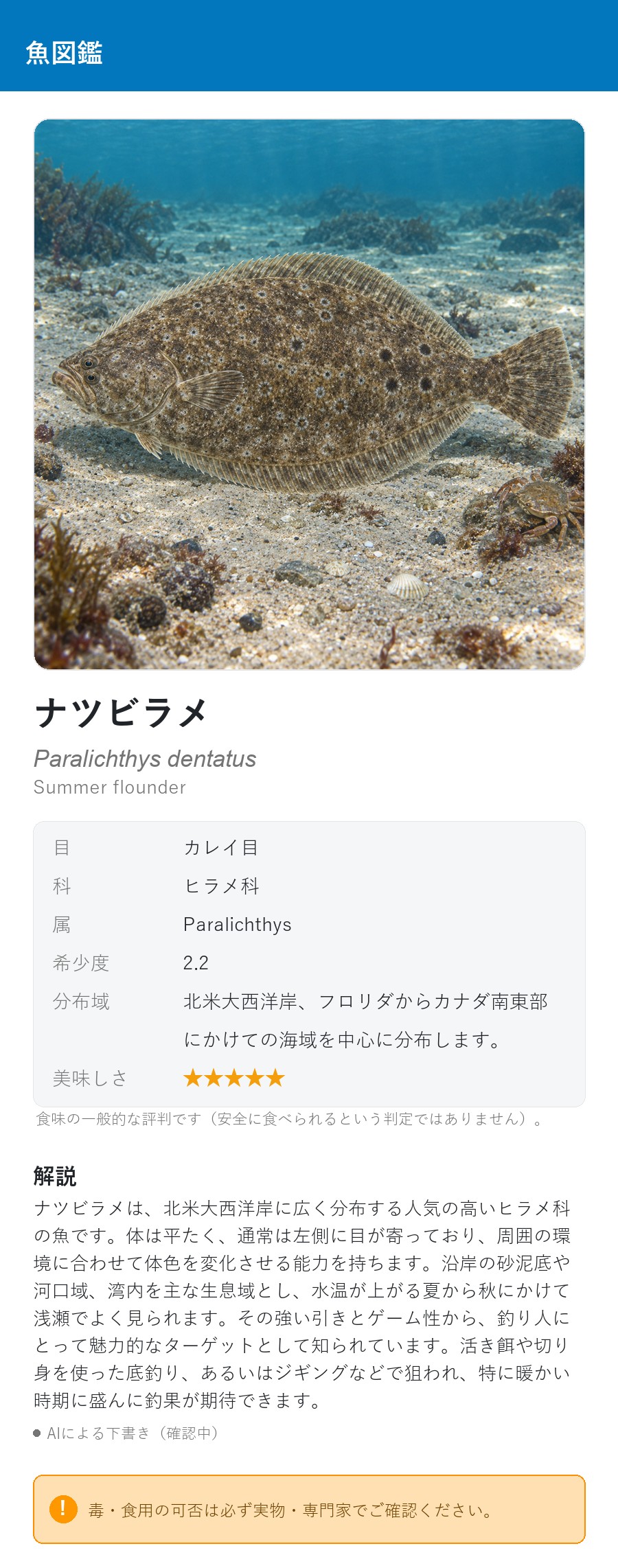
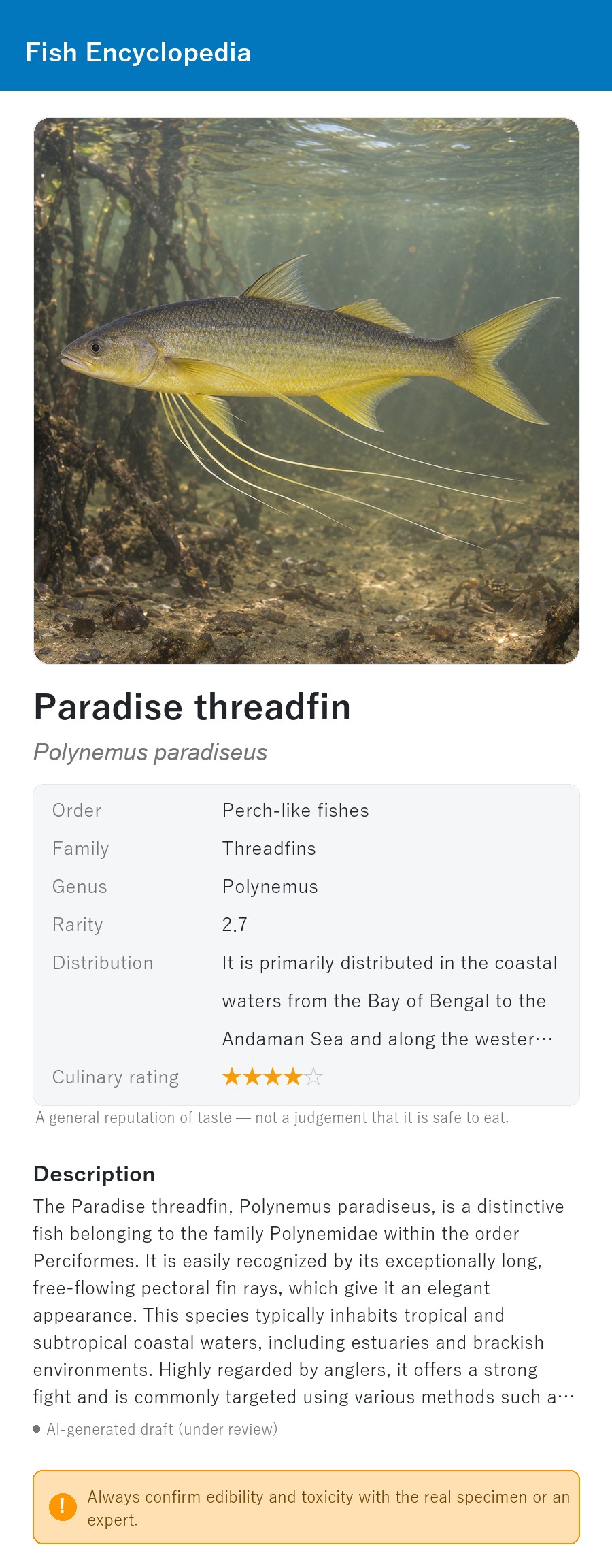
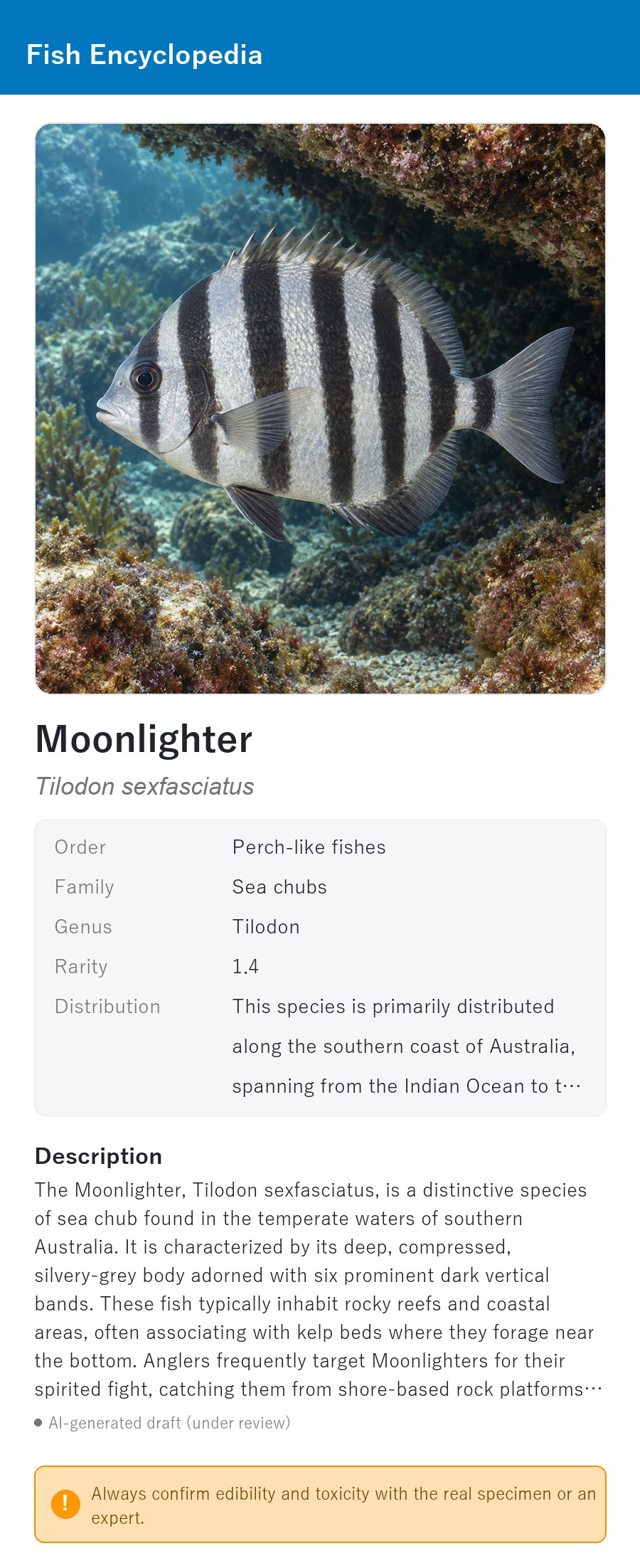
アプリの魚図鑑での表示イメージ。日本語・英語どちらの表示にも対応しています。イラストは左右にスワイプ(Web版はイラスト下の左右ボタン)で白背景版と切り替えられます。生息イメージ版がまだ用意できていない種は、これまでどおり白背景版の1枚だけを表示します。
今回のテーマも「その科の最後の数種」
図鑑は「目 → 科 → 属 → 種」とたどれます。前回までに「あと8種以内で揃う科」をすべて埋めたので、今回は「あと9種から12種で、その科の全種が2枚立てになる」14の科をまとめて描きました。ニシン科(欧米の川を遡る「Allis shad」「Twaite shad」、アメリカンシャッド、ベンガルの「Hilsa」)、豪州とパタゴニアの淡水魚ペルキクティス科、カレイ科・ヒラメ科、ツバメコノシロ科、ワタリガニ科、カワアナゴ科、アジアとアフリカのナマズギギ科、カジカ科、豪州の川のシマイサキ科、モンガラカワハギ科、北米のサッカー科、イスズミ科(メジナの仲間を含む)、ヒメジ科です。
このうち11の科は、科のページを開けばすべての種で2枚のイラストが切り替わるようになりました。カレイ科とペルキクティス科は、図鑑側に別の学名で重複して載っている行(整理予定)が1つずつ残っているため、それを除いて揃っています。ヒメジ科は下に書くとおり、あと1種です。
カレイ・ヒラメは18種、向きも眼の斑も1点ずつ
「左ヒラメに右カレイ」。今回はカレイ科8種(頭を右)とヒラメ科10種(頭を左)が入りました。北海道のクロガレイ、東北のミギガレイ、ベーリング海のウマガレイ、欧州の「European flounder」「Lemon sole」、北米西岸の「Petrale sole」「Pacific sand sole」、矢じりのような歯の「Arrowtooth flounder」。ヒラメ科は、二重の眼状斑をもつメガレイ、眼状斑がちょうど5個の小さなヒラメ(Pseudorhombus pentophthalmus)、サイコロの「5」の目のように斑が並ぶナツビラメ、逆に眼状斑を持たない「Southern flounder」とカリフォルニアビラメ、内湾の小さなアラメガレイ・ユメアラメガレイ、インド太平洋のテンジクガレイ。頭の向きと眼状斑の数は18種すべてで確認しました。
「本数」が決め手の仲間たち
ツバメコノシロの仲間は、胸びれの下に伸びる糸(遊離軟条)の本数で種が分かれます。西アフリカの巨大な「Giant African threadfin」とミナミコノシロは4本、ツバメコノシロ・豪州の「King threadfin」・黒ずんだ「Indian threadfin」は5本、ハワイの「Sixfinger threadfin」と肩に黒斑のあるカタグロアゴナシは6本、「Paradise threadfin」は7本。9種とも、原寸に拡大して糸を1本ずつ数えています。ギギの仲間は口ヒゲ8本(インドの「Rita」だけ6本)、ワタリガニの仲間は脚10本で最後の1対が泳ぐための櫂の形——こちらも同じように確認しました。カニはワタリイシガニ・フタホシイシガニと、アオガザミの親戚6種(メキシコ・カリブ・ブラジル・西アフリカ)、紅海の青いガザミです。
サンゴ礁の個性派と、砂底をヒゲで探る魚
モンガラカワハギ科は12種。緑に橙の波線のクマドリ、全身が黒いソロイモンガラと、白いひれ・桃色の尾のクロモンガラ、黄色い縁取りのキヘリモンガラ、ムラサメモンガラによく似て腹に大きな黒斑をもつクラカケモンガラ、紅海のアラビアンピカソトリガー、ムスメハギ・ツマジロモンガラ・メガネハギ・スジナメモンガラ、沖のオキハギ、流れ藻につくアミモンガラ。ヒメジ科は、黒い線と点のオオスジヒメジ、尾びれに縞のあるヨメヒメジ、黄色い鞍をもつマルクチヒメジ、金色の小判のような斑のコバンヒメジ、リュウキュウヒメジ・モンツキアカヒメジ・リュウキュウアカヒメジ、磯釣りでおなじみのホウライヒメジ(Parupeneus ciliatus)、地中海の「Striped red mullet」、カリブ海の「Spotted Goatfish」など11種です。
世界の川からも
北米のサッカー科12種(尾の赤い「Greater redhorse」「River redhorse」と、名前に反して尾が灰色の「Golden redhorse」、背びれが羽根ペンのように伸びる「Lake quillback」、青黒い流線形の「Blue Sucker」など)。豪州のシマイサキ科11種(マレー・ダーリング水系の「Silver perch」、砂漠の泉にもすむ「Spangled perch」、黒地に金色の模様の Hephaestus carbo など)とペルキクティス科8種(ぬるぬるした「River blackfish」、繁殖期の雄のひれが赤い「Southern pygmy perch」、クラレンス川とメアリー川の希少なコッド)。アジア・アフリカのギギ科11種(尾の赤いメコンの「Asian red tailed catfish」、マラウイ湖のカンパンゴ、脂びれに黒い丸のあるインドの大ナマズ2種)。カワアナゴ科は、マングローブの根に逆さに付くノコギリハゼ、チチブモドキ・テンジクカワアナゴ・オカメハゼ・ホシマダラハゼ、東南アジアの大きな「Marbled goby」。北海道の川のハナカジカ・エゾハナカジカも入りました。
常連グループも積み増しました
残り種数がまだ多い定番グループからも選んでいます。ハゼの仲間を18種(枝サンゴにすむ緑のベニサシコバンハゼとフタイロサンゴハゼ、真っ黒なクロダルマハゼと黄色いアカネダルマハゼ、洞窟で頭を上にして群れるアオギハゼ、旗竿のような背びれのハタタテシノビハゼ、ジュウモンジサラサハゼ・ホホベニサラサハゼ・スフィンクスサラサハゼ、内湾の泥にすむ紅色のアカウオなど)、コイの仲間を12種(諏訪湖のナガブナ、欧州の「White bream」「Spirlin」、ナイフのような体の「Sichel」、北米の「Golden shiner」「Creek chub」「Hornyhead chub」、南アフリカのイエローフィッシュ2種など)、ハタの仲間を11種(青紫の線が鮮やかなミナミハタ、サミダレハタ・ミナミイソハタ・ヒトミハタ・アマダレドクハタ・ヒレグロハタ・ホシヒレグロハタ、地中海の「Goldblotch grouper」「Comber」、カリフォルニアのサンドバス2種)、アジの仲間を7種(ホソヒラアジ・ミナミイケカツオ・ナンヨウカイワリ・クロヒラアジなど)、フエダイの仲間を8種(キンセンフエダイ・タテフエダイ・ニセクロホシフエダイ・ミナミフエダイ、深場のシマチビキ、カリブ海の「Dog snapper」「Schoolmaster snapper」など)。
今回は、描いてもらう前にも検算しました
イラストは「この種はここが決め手」というメモを付けて依頼しています。学名や分布はデータベースから自動で入るので、間違いが残るとすればこの手書きのメモです。そこで今回は依頼する前に、メモ200件を図鑑や魚類データベースの記載と1件ずつ突き合わせました。結果、約25件を修正。たとえばホウライヒメジとオキナヒメジを見分ける決め手を逆に書いていたり、別の種の特徴(糸のように伸びる尾びれ)を書いていたりしました。メモが間違っていると、絵はメモどおりに仕上がり、検査もすべて通ってしまいます。直したところは、直したとおりに描かれて届きました。
全点を目視で確認、1種は描き直しへ
寸法やファイル名の機械的なチェックとは別に、納品されたイラスト200点すべてを1枚ずつ目で見て種を照合する工程を今回も行いました。その結果、199点が合格、1点を描き直しにしています。描き直しになったのはオキナヒメジ(Parupeneus spilurus)で、同じ仲間の有名な魚「オジサン」の模様(背から腹への帯)で描かれていました。本来の模様は頭から尾へ走る帯です。間違った絵は掲載していません。この種は描き直しが届くまで、白背景版の1枚だけを表示します(ヒメジ科はこの1種が入れば全種が揃います)。お気づきの点があれば、ぜひアプリの「バグ報告」からお知らせください。
ご注意
- 図鑑の絵は写真ではなくイラストです。 生息イメージ版は水中での見え方を伝えるために描いたもので、特定の個体や実際の撮影地を記録したものではありません。
- 毒の有無や種の判断は、必ず実物と専門家の確認をお願いします。 図鑑の表示は参考情報であり、安全を保証するものではありません。
- 解説の一部は AI による下書きで、順次見直しを進めています。お気づきの点はアプリの「バグ報告」からお知らせください。
- 名称・分類データは GBIF を出典としています。図鑑のイラストの著作権は世界釣りマップに帰属します。無断転載・二次利用はご遠慮ください。
Encyclopedia illustrations come in two versions — a plain one and an in-habitat one. Following the previous 200 species, another 199 now have both versions, for a total of 2,094 species. No species were added; the encyclopedia still covers about 2,939.
How species look in the app encyclopedia — available in both Japanese and English. Swipe the illustration left or right to switch versions (on the web, use the arrow buttons below it). Species without in-habitat artwork simply show the single plain illustration, exactly as before.
Again, "the last few species in the family"
The encyclopedia is browsable by order, family, genus and species. Having already filled every family that was eight or fewer species short, this time we took on the 14 families that were nine to twelve species short of complete coverage: the shads and herrings, the temperate perches of Australia and Patagonia, the righteye and lefteye flounders, the threadfins, the swimming crabs, the sleepers, the bagrid catfishes of Asia and Africa, the sculpins, the grunters of Australian rivers, the triggerfishes, the North American suckers, the sea chubs and nibblers, and the goatfishes.
In 11 of those families, every species now switches between both illustrations. The righteye flounders and the temperate perches each still have one leftover row that duplicates another species under an older scientific name (to be merged), and the goatfishes are one species short — see below.
Eighteen flatfishes — facing the right way
This batch brought eight righteye flounders (head to the right) and ten lefteye flounders (head to the left): European flounder, Lemon sole, Petrale sole, Pacific sand sole, Flathead sole, Arrowtooth flounder and two from northern Japan; then Summer flounder with its dice-like cluster of eyespots, Southern flounder and California halibut with none, the Fivespot flounder with exactly five, Cartwright's flounder with its double ocelli, Largetooth flounder, and two tiny Japanese sand flounders. We checked the facing and the eyespot count on all eighteen.
Families where the count is the key
Threadfins are told apart by the number of free filaments under the pectoral fin: four in the Giant African threadfin and the East Asian fourfinger threadfin, five in the Striped, King and Indian threadfins, six in the Sixfinger and Blackspot threadfins, seven in the Paradise threadfin. We zoomed in and counted them on all nine. Bagrid catfishes have eight barbels (six in Rita), and swimming crabs have ten legs with the last pair flattened into paddles — checked the same way. The crabs include two Charybdis from Japan, six relatives of the blue crab from Mexico, the Caribbean, Brazil and West Africa, and the blue swimming crab of the Red Sea.
Reef characters, and fish that probe the sand
Twelve triggerfishes: Orange-lined, Black durgon and Pinktail, Yellowmargin, Blackbelly (a lookalike of the lagoon triggerfish with a big black belly patch), the Arabian Picasso of the Red Sea, Boomerang, Flagtail and Masked triggerfishes, Striped triggerfish, Starry triggerfish and the oceanic Rough triggerfish. Eleven goatfishes: Dash-and-dot, Freckled, Gold-saddle, Indian, Sidespot, Yellowstripe, Orange and Whitesaddle goatfishes, plus the Red Sea goatfish, the Striped red mullet of the Mediterranean and the Spotted goatfish of the Caribbean.
From the world's rivers
Twelve North American suckers (the red-tailed Greater and River redhorses, the Golden redhorse whose tail is actually grey, Quillback, Blue sucker, two buffalo fishes); eleven Australian grunters (Silver perch, Spangled perch, Sooty grunter, Coal grunter); eight temperate perches (River blackfish, Southern pygmy perch, the rare Eastern freshwater cod and Mary River cod, Macquarie perch, Creole perch); eleven bagrid catfishes (the red-tailed giant of the Mekong, Kampango of Lake Malawi, two big Indian river catfishes with a black spot on the adipose fin); ten sleepers (Duckbill sleeper, Marbled goby, Sleepy cod, Purple-spotted gudgeon); and two freshwater sculpins from the rivers of Hokkaido.
The regulars kept growing too
We also kept working through the big groups: 18 gobies (coral gobies that live among Acropora branches, the all-black Dark coral goby, a cave-hovering pygmygoby, three shrimpgobies, the red eel-like Comb goby of Japanese mudflats), 12 carps and minnows (White bream, Spirlin, Sichel, Golden shiner, Creek chub, Hornyhead chub, Central stoneroller, Silver barb, two South African yellowfishes), 11 groupers (Harlequin, Bluespotted and Leopard hinds, Greasy grouper, Highfin coralgrouper, Goldblotch grouper, Comber, Spotted and Barred sand basses), 7 jacks (Blue runner, Yellowstripe scad, Needlescaled queenfish, Island and Blue trevallies, Largespotted dart, Atlantic bumper) and 8 snappers (Bigeye, Brownstripe, Dory and Blackspot snappers, Oblique-banded snapper, Dog, Schoolmaster and Lane snappers).
This time we also checked the brief before sending it
Each illustration is commissioned with a short note on what identifies the species. Names and ranges come straight from the database, so any remaining mistakes live in those hand-written notes. This time we checked all 200 notes against published descriptions before ordering and corrected about 25 — for example, we had swapped the feature that separates two lookalike goatfishes, and had described another species' trailing tail filaments on a triggerfish. When a note is wrong, the artwork faithfully follows it and passes every check. The corrected notes came back drawn as corrected.
Every illustration checked by eye — one sent back
Alongside the mechanical checks on dimensions and file naming, we again reviewed all 200 delivered illustrations one by one and verified each species. 199 passed and one is being redrawn: the Blackspot goatfish (Parupeneus spilurus) arrived with the vertical bars of its famous relative, the Manybar goatfish, instead of its own head-to-tail stripes. The incorrect artwork was not published; that species shows only its plain illustration until the redraw arrives. If you spot something, please tell us through "Report a bug" in the app.
Notes
- These are illustrations, not photographs. The in-habitat version is drawn to convey how a species looks underwater; it does not record a particular individual or a real location.
- Always confirm identification and venomousness with the real specimen and an expert. Entries in the encyclopedia are reference information and are not a guarantee of safety.
- Some descriptions are AI-generated drafts that we are reviewing over time. If you spot an error, please tell us through "Report a bug" in the app.
- Names and taxonomy are sourced from GBIF. The encyclopedia illustrations are © World Fishing Map; please do not reproduce or reuse them without permission.