
「生息イメージ」のイラストをさらに200種へ追加しました(合計1,895種)
魚図鑑のイラストは、種によって「白背景版」と「生息イメージ版」の2枚を用意しています。前回の200種に続いて、今回はさらに200種が2枚立てになり、合計1,895種になりました。収録種数は約2,939種のままで、種の追加はありません。
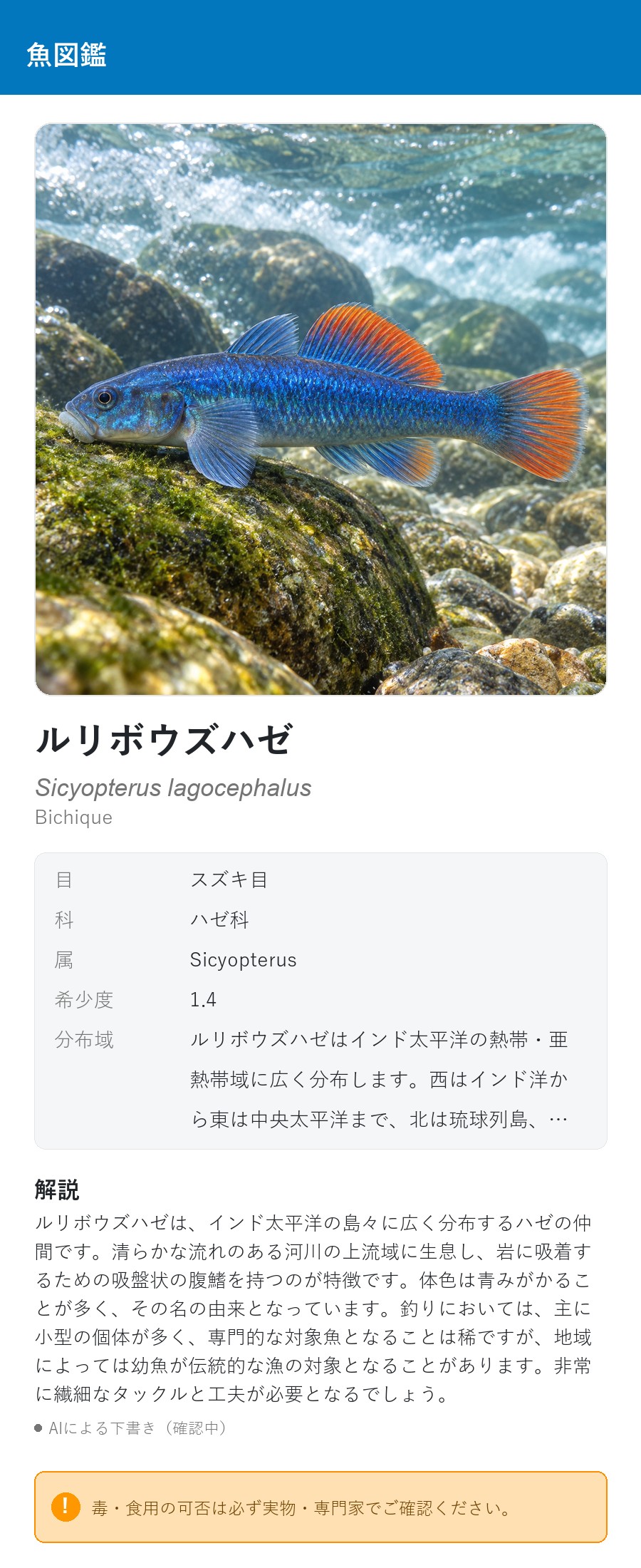
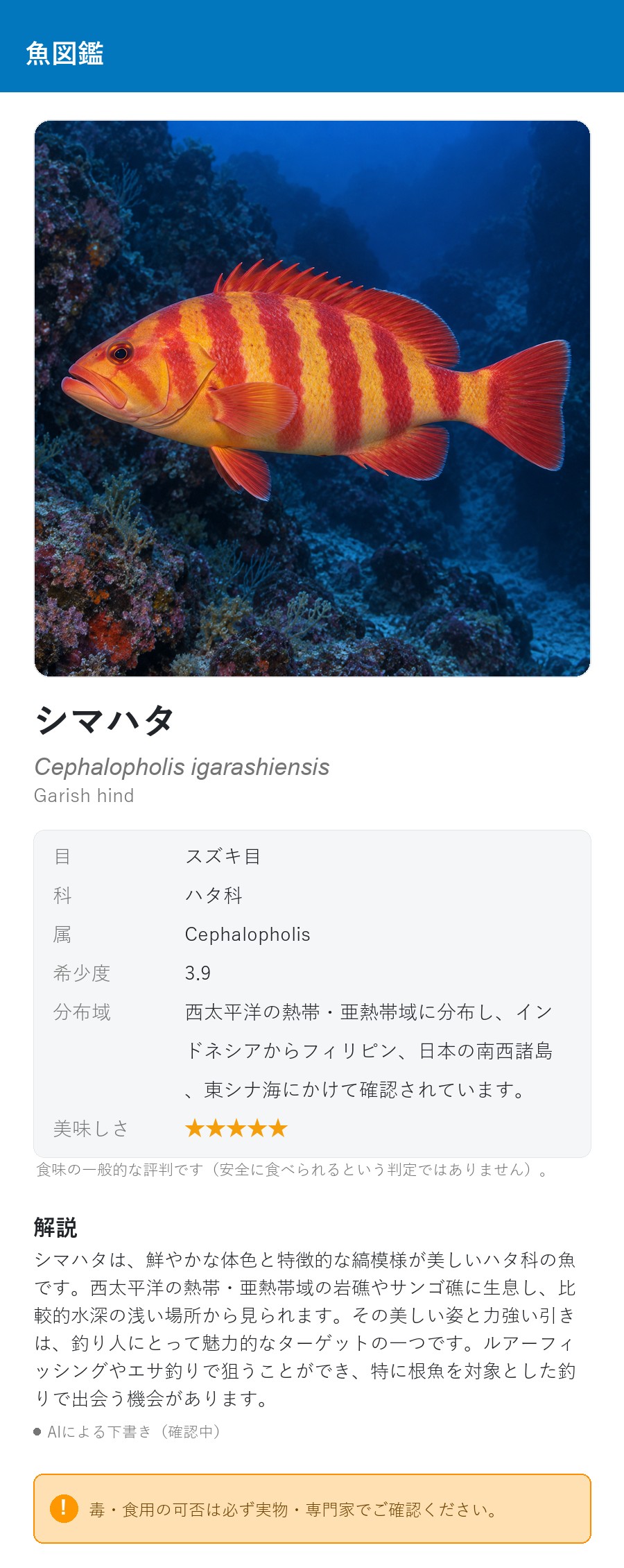
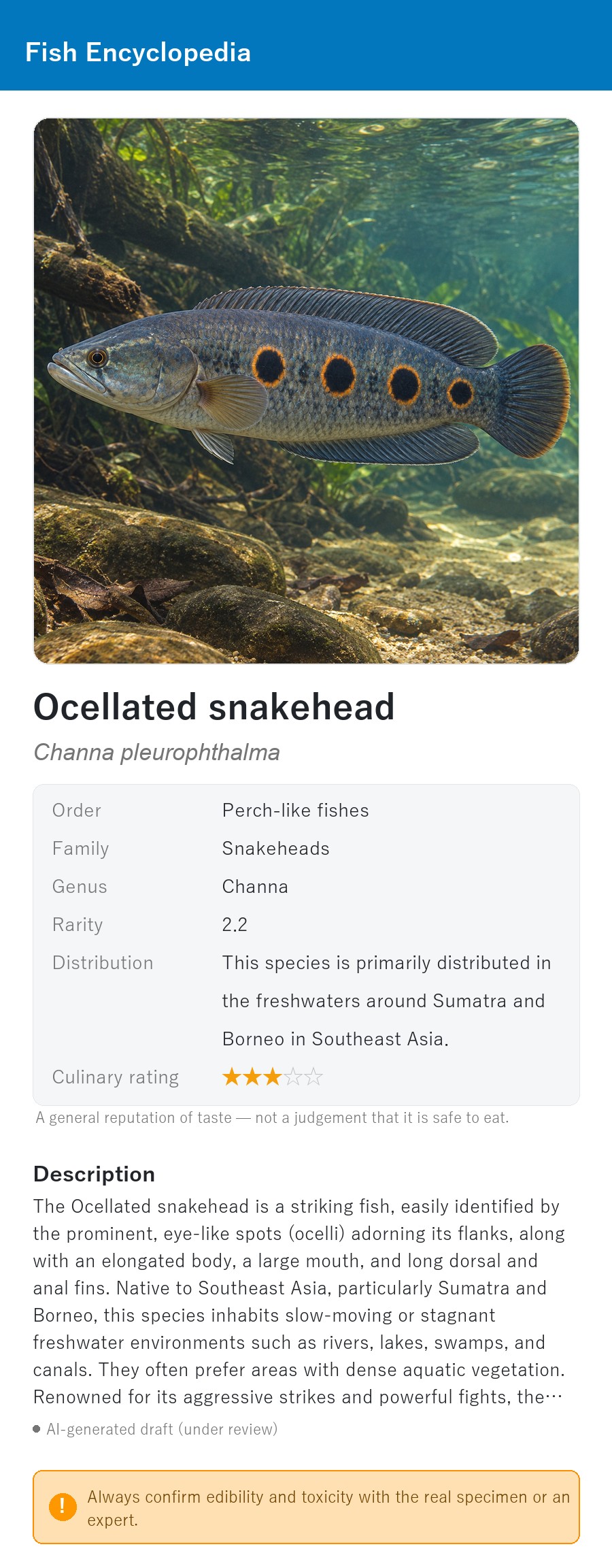
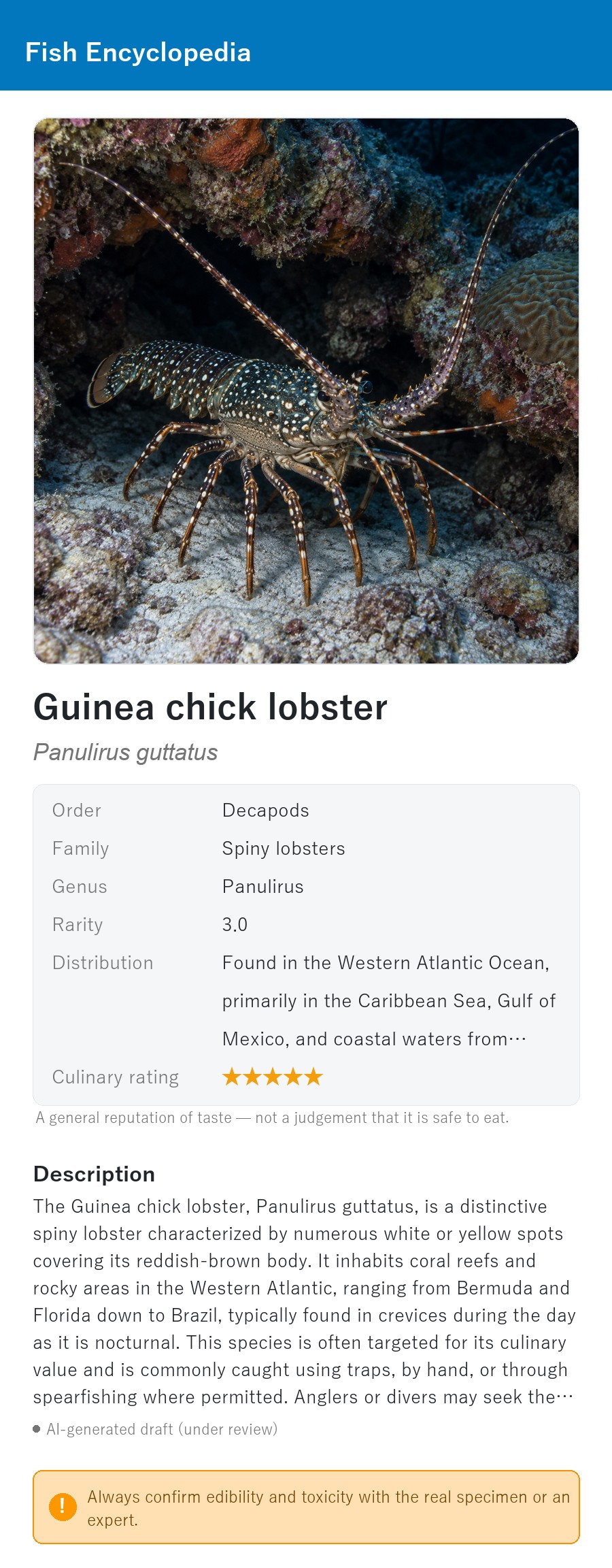
アプリの魚図鑑での表示イメージ。日本語・英語どちらの表示にも対応しています。イラストは左右にスワイプ(Web版はイラスト下の左右ボタン)で白背景版と切り替えられます。生息イメージ版がまだ用意できていない種は、これまでどおり白背景版の1枚だけを表示します。
今回のテーマも「その科の最後の数種」
図鑑は「目 → 科 → 属 → 種」とたどれます。前回、「あと3〜5種で揃う科」を40埋めたのに続いて、今回は「あと6種から8種で、その科の全種が2枚立てになる」科を22見つけて、すべて埋めました。さらに、前回の整理で1種だけ残っていたユメタカノハダイの科(Latridae)も今回で揃いました。北大西洋のタラ科(「Saithe」「Bib」「Poor cod」など)、南日本のアナゴ科(ハナアナゴ・ツマグロアナゴ・キリアナゴ・メダマアナゴなど7種)、コチ科(トカゲゴチ・オニゴチ・ミナミマゴチと豪州のコチ4種)、サヨリ科・ダツ科・アマダイ科・キス科・イットウダイ科・イトヨリダイ科・タカノハダイ科、北米・欧州のペルカ科・アメリカナマズ科、南米のブリコン科・ピメロドゥス科、アジア・アフリカのタイワンドジョウ科、そしてヤリイカ・コウイカ・マダコ・クルマエビ・イセエビ・テナガエビの6つの科——この23の科では、科のページを開けばすべての種で2枚のイラストが切り替わります。
イカ・タコ・エビは過去最多の46種
今回は頭足類20種・甲殻類26種と、無脊椎動物がこれまでで最も多い回になりました。北海の「Veined squid」、南アフリカのアフリカヤリイカ、地中海の小さなコウイカ「Sepia elegans」「Sepia orbignyana」、日本のマドカコウイカ、東南アジアのミナミシリヤケイカ、白い斑点が星空のようなコブシメダコ、両眼の下に大きな眼状斑をもつメキシコの「Mexican red octopus」、メキシコ湾のクルマエビ4種、南アフリカ・ブラジル・カリブ海・豪州のイセエビ8種、そして日本の川のミナミテナガエビ・ヒラテテナガエビを含むテナガエビ6種。イカは腕8本と触腕2本、タコは腕8本、エビ類は脚10本——本数はすべて1点ずつ確認しています。
常連グループも積み増しました
残り種数がまだ多い定番グループからも選んでいます。ハゼの仲間を16種(瑠璃色の雄が美しいルリボウズハゼ、干潟のキララハゼ、逆さに岩穴に付くベンケイハゼ、トウカイヨシノボリ・シマヒレヨシノボリ、北欧の「Sand goby」など)、コイの仲間を10種(北海道のエゾウグイ、欧州の「Crucian carp」「Common nase」「Eurasian minnow」、メコンの「Hampala barb」「Jullien's golden carp」など)、ハタの仲間を11種(ハナハタ・シマハタ・コクハンハタ・イシガキハタ・シモフリハタ・カケハシハタ・ヤマブキハタ・タテスジハタ・ハナゴイと地中海の「White grouper」「Painted comber」)、アジの仲間を6種(モロ・アカアジ・オオクチイケカツオ・アイブリ・クロアジモドキと「Atlantic horse mackerel」)、タイの仲間を7種(オキナワキチヌ・タイワンダイ・ヨーロッパマダイ・アフリカチヌ、豪州の「Black bream」、地中海の「White seabream」「Salema」)。
「そっくりさん」は32組
科の残り全部を拾うと、同じ属の6〜8種がまとめて入ります。今回は決め手を1行ずつ指定した組が32組——タラ科の小型3種は顎ヒゲと帯の有無、アナゴ科7種は鰭の縁の黒色と眼の大きさ、マツカサ属7種は鰭の色と鰓蓋の暗色帯の長さ、スヌーク7種は臀びれの棘の長さと海域、ブルヘッド3種は顎ヒゲの色、タイガーショベルノーズ4種は帯の形(輪状・直線・網目)——で、全組が描き分けられて納品されました。前々回に1種だけ起きた「実物には無い模様を足す」ミスも、今回はありませんでした。
今回追加したおもな種
- 北大西洋の冷たい海 — タラ科の「English whiting」「Saithe」「Bib」「Poor cod」、プタスダラ、北米東岸のカナダコマイ。
- 日本と西太平洋の海 — ハナアナゴ・ツマグロアナゴ・ソコアイアナゴ・キリアナゴ・メダマアナゴ・アイアナゴ、トカゲゴチ・オニゴチ・ミナミマゴチ、ユウダチタカノハ、スミツキアマダイ、トウザヨリ・ホシザヨリ・クルメサヨリ・センニンサヨリ・サヨリトビウオ、ハマダツ・ヒメダツ・リュウキュウダツ・テンジクダツなど。
- サンゴ礁とインド洋 — ツマグロマツカサ・キビレマツカサ・セグロマツカサなどマツカサの仲間7種、ニホンイトヨリ・ユメイトヨリ・シャムイトヨリ、ヒメタマガシラ・ヒトスジタマガシラ、ヤセアマダイ・キツネアマダイ、うなじに青い帯をもつ「Blue-saddled tilefish」。
- 南半球の温帯の海 — 豪州の「Tiger flathead」「Southern flathead」、NZの「Brownbanded morwong」、南アフリカの「Two-tone fingerfin」「Bank steenbras」、豪州東岸の「Red morwong」、アメギスなど豪州のキス4種。
- 世界の淡水 — 中南米のスヌーク7種(「Fat snook」「Tarpon snook」「White snook」など)、北米の「Sauger」「Common logperch」とブルヘッド3種、欧州の「Ruffe」「Volga pikeperch」、中央アジアの「Balkhash perch」、南米のブリコンの仲間6種と「Tabarana」、ピメロドゥスの仲間8種(「Magdalena sorubim」「Barred sorubim」など)、東南アジア・インド・アフリカのスネークヘッド8種(「Ocellated snakehead」「Forest snakehead」「African snakehead」など)。
- イカ・タコ・エビ — アフリカヤリイカ・アジアジンドウイカ・マドカコウイカ・ヤセコウイカ・ミナミシリヤケイカ・コブシメダコ・ソデフリダコ、フトミゾエビ、インドイセエビ、ザラテテナガエビ・ミナミテナガエビ・ヒラテテナガエビのほか、「Patagonian squid」「Maori octopus」「Cape crawfish」「Eastern rock lobster」「Amazon river prawn」など。イカ・タコ・エビは海底や岩の割れ目で暮らしている姿で描いています。
全点を目視で確認しています
寸法やファイル名の機械的なチェックとは別に、納品されたイラスト200点すべてを1枚ずつ目で見て種を照合する工程を今回も行いました。疑わしいものは原寸まで拡大して図鑑の記載と突き合わせています。その結果、今回は差し替えが必要なものはありませんでした。お気づきの点があれば、ぜひアプリの「バグ報告」からお知らせください。
ご注意
- 図鑑の絵は写真ではなくイラストです。 生息イメージ版は水中での見え方を伝えるために描いたもので、特定の個体や実際の撮影地を記録したものではありません。
- 毒の有無や種の判断は、必ず実物と専門家の確認をお願いします。 図鑑の表示は参考情報であり、安全を保証するものではありません。
- 解説の一部は AI による下書きで、順次見直しを進めています。お気づきの点はアプリの「バグ報告」からお知らせください。
- 名称・分類データは GBIF を出典としています。図鑑のイラストの著作権は世界釣りマップに帰属します。無断転載・二次利用はご遠慮ください。
Encyclopedia illustrations come in two versions — a plain one and an in-habitat one. Following the previous 200 species, another 200 now have both versions, for a total of 1,895 species. No species were added; the encyclopedia still covers about 2,939.
How species look in the app encyclopedia — available in both Japanese and English. Swipe the illustration left or right to switch versions (on the web, use the arrow buttons below it). Species without in-habitat artwork simply show the single plain illustration, exactly as before.
Again, "the last few species in the family"
The encyclopedia is browsable by order, family, genus and species. Last time we filled the 40 families that were three to five species short. This time we found 22 families that were six to eight species short of complete coverage — and filled every one of them, plus the single species left over in the trumpeter family (Latridae): the cods of the North Atlantic, the conger eels and flatheads of Japan, the halfbeaks and needlefishes, the tilefishes, whitings, soldierfishes, threadfin breams and morwongs, the perches and bullhead catfishes of North America and Europe, the brycons and pimelodid catfishes of South America, the snakeheads of Asia and Africa — and six families of squid, cuttlefish, octopus, prawns, spiny lobsters and river prawns. In those 23 families, every species now switches between both illustrations.
A record 46 squid, octopus and crustaceans
With 20 cephalopods and 26 crustaceans, this is our largest batch of invertebrates yet: the Veined squid of the North Sea, the Cape Hope squid on its egg beds, the small Mediterranean cuttlefishes, the Starry night octopus, the Mexican four-eyed octopus, four Gulf of Mexico penaeid shrimps, eight spiny lobsters from South Africa, Brazil, the Caribbean and Australia, and six river prawns including two from Japanese streams. Squid have eight arms and two tentacles, octopus eight arms, and decapods ten legs — we counted every one.
The regulars kept growing too
We also kept working through the big groups: 16 gobies (the blue Red-tailed goby, the Sand goby of northern Europe, two Japanese stream gobies), 10 carps and minnows (Sakhalin dace, Crucian carp, Common nase, Eurasian minnow, Hampala barb, Jullien's golden carp), 11 groupers (Golden, Garish and Sixblotch hinds, Starspotted, Halfmoon and Oblique-banded groupers, Golden grouper, Purple queen, White grouper and Painted comber), 6 jacks and scads, and 7 seabreams (Okinawa yellowfin seabream, Black bream, Red porgy, White seabream, Two-banded seabream, Salema).
Lookalikes: 32 sets
When you take every remaining species in a family, six to eight congeners arrive together. This time the brief carried 32 sets of lookalikes, each with a one-line distinguishing note — chin barbels and bars for the small cods, fin margins and eye size for seven congers, fin colour and gill-cover band for seven soldierfishes, anal-spine length and ocean for seven snooks, barbel colour for three bullheads, and bar shape (loops, straight, or net-like) for four tiger shovelnose catfishes — and every set came back distinct. The "adding a pattern the fish does not have" error seen two batches ago did not recur.
What this update covers
- Cold North Atlantic — English whiting, Atlantic tomcod, Blue whiting, Saithe, Bib and Poor cod.
- Japan and the western Pacific — Seven congers, four Japanese flatheads, the Japanese morwong Goniistius quadricornis, two horsehead tilefishes, six halfbeaks and six needlefishes.
- Coral reefs and the Indian Ocean — Seven soldierfishes, five threadfin breams and two monocle breams, the Blue-saddled tilefish and two blanquillos, the Arabian sillago.
- Temperate southern seas — Tiger, Rock and Southern flatheads, Brownbanded and Crested morwongs, Two-tone fingerfin, Bank steenbras, Grey morwong, Red morwong and four Australian whitings.
- World freshwater — Seven snooks and the Blackline tilefish of the Americas; Ruffe, Balkhash perch, Common logperch, Sauger, Estuarine perch and Volga pikeperch; White catfish, three bullheads and three Ictalurus catfishes; six brycons and the Tabarana; eight pimelodid catfishes including four tiger shovelnoses; eight snakeheads.
- Squid, octopus and crustaceans — Six loliginid squid, six cuttlefishes, eight octopuses, six penaeid prawns, eight spiny lobsters and six river prawns — all drawn as they live, on the seabed or in reef crevices.
Every illustration was checked by eye
Alongside the mechanical checks on dimensions and file naming, we again reviewed all 200 delivered illustrations one by one and verified each species, zooming to full size wherever something looked off. This time none needed to be redrawn. If you spot something, please tell us through "Report a bug" in the app.
Notes
- These are illustrations, not photographs. The in-habitat version is drawn to convey how a species looks underwater; it does not record a particular individual or a real location.
- Always confirm identification and venomousness with the real specimen and an expert. Entries in the encyclopedia are reference information and are not a guarantee of safety.
- Some descriptions are AI-generated drafts that we are reviewing over time. If you spot an error, please tell us through "Report a bug" in the app.
- Names and taxonomy are sourced from GBIF. The encyclopedia illustrations are © World Fishing Map; please do not reproduce or reuse them without permission.