
魚図鑑のイラストは、種によって「白背景版」と「生息イメージ版」の2枚を用意しています。前回の200種に続いて、今回はさらに200種に生息イメージ版を追加しました。2枚立てになった種は合計1,294種です。収録種数は約2,940種のままで、種の追加はありません。
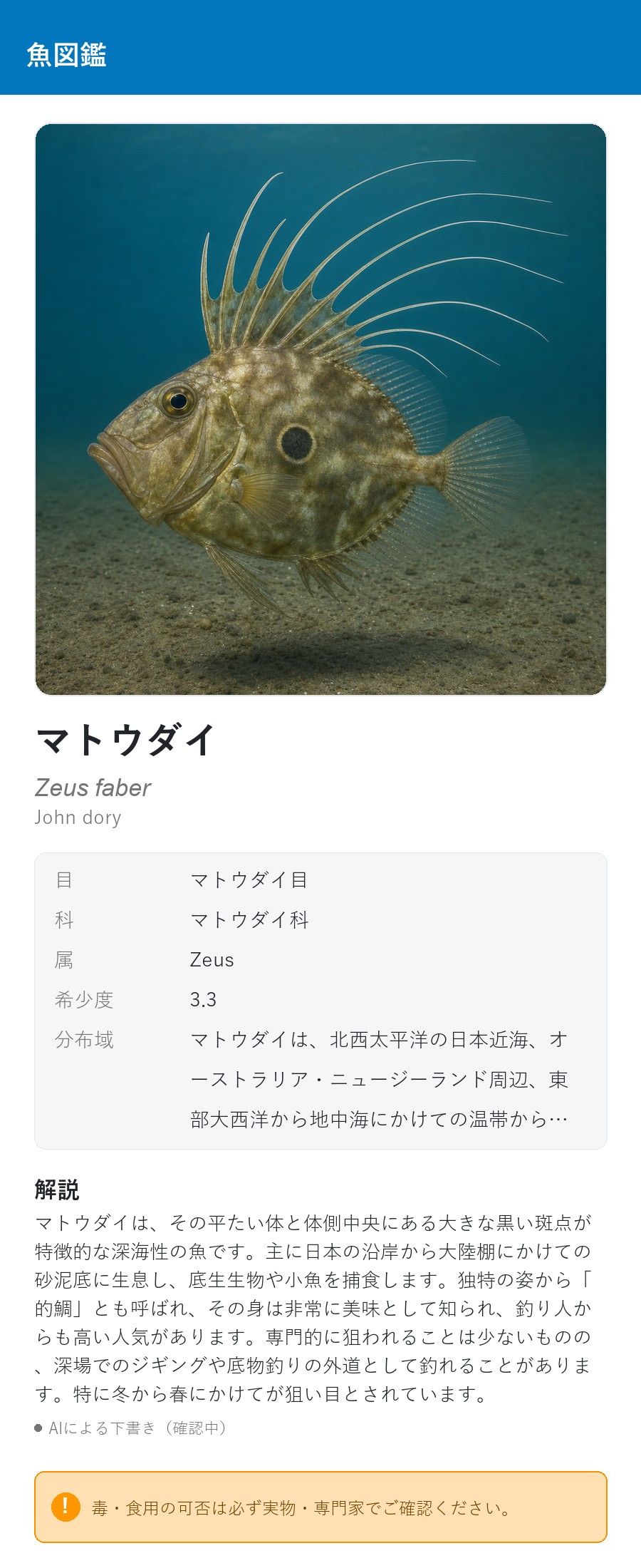
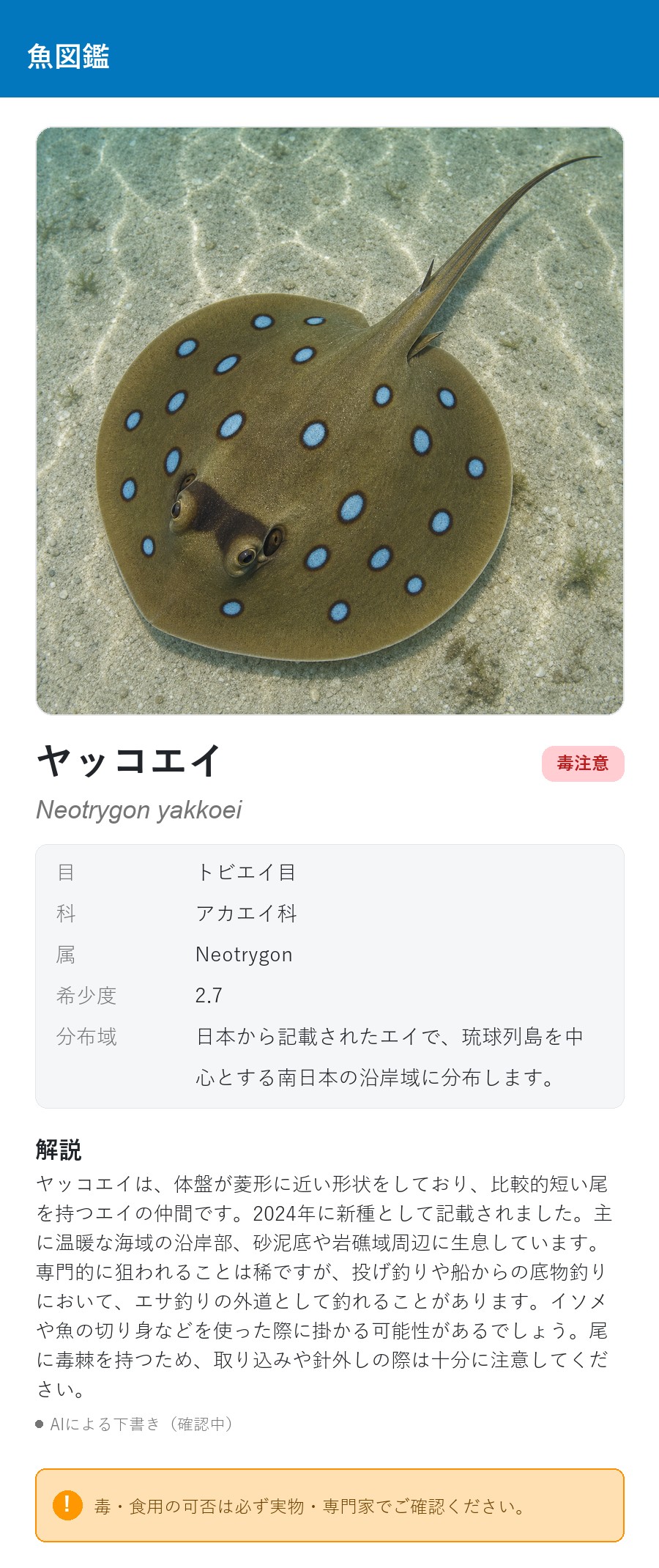
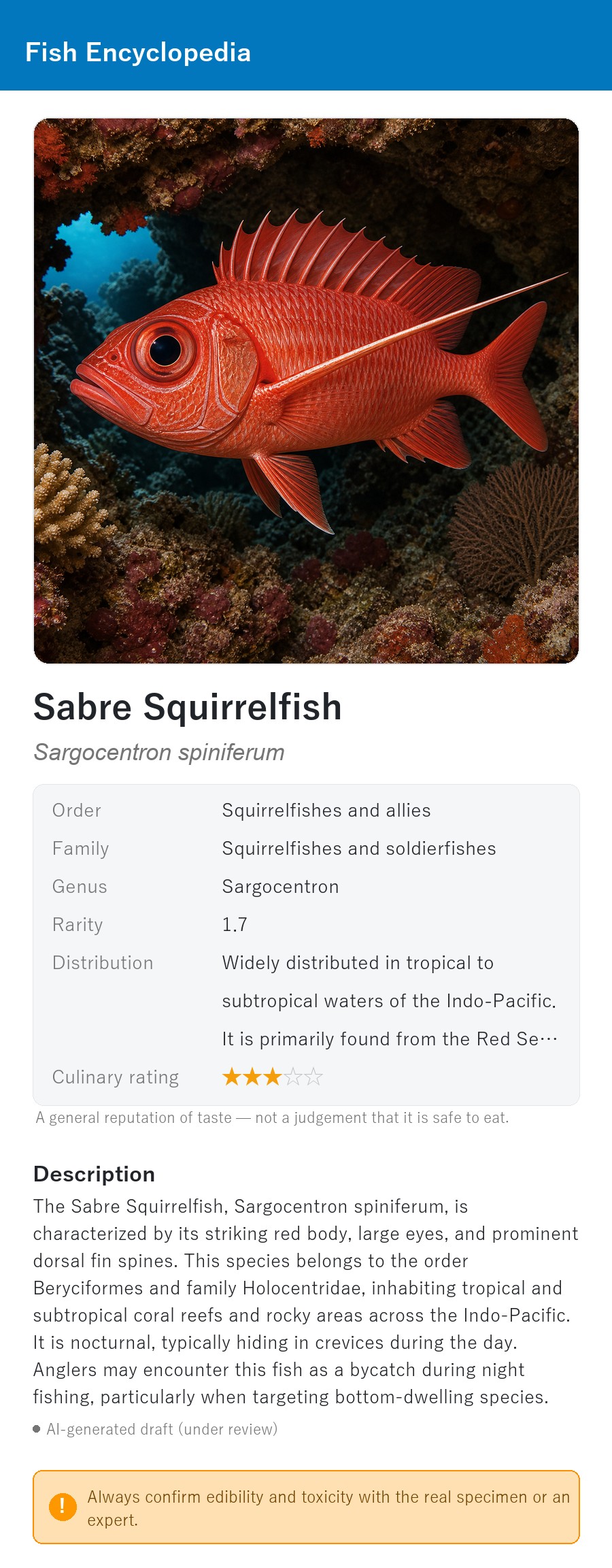
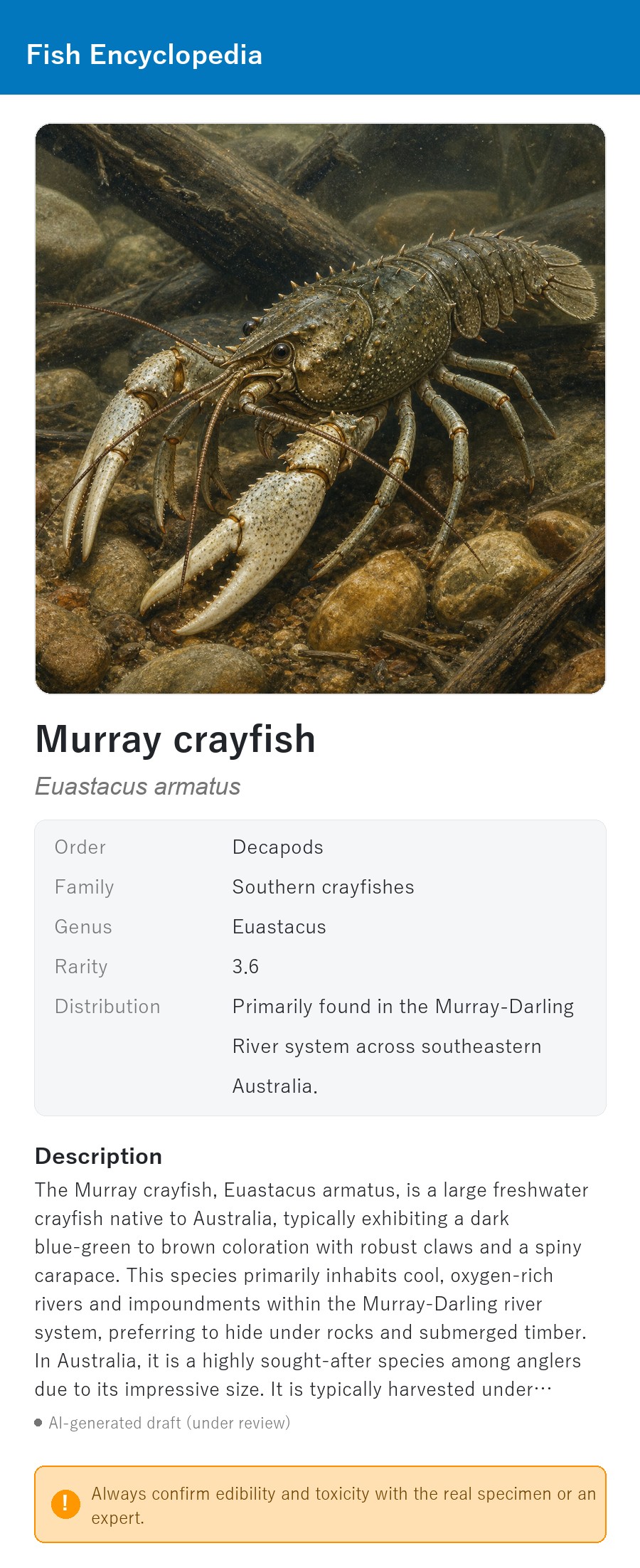
アプリの魚図鑑での表示イメージ。日本語・英語どちらの表示にも対応しています。イラストは左右にスワイプ(Web版はイラスト下の左右ボタン)で白背景版と切り替えられます。生息イメージ版がまだ用意できていない種は、これまでどおり白背景版の1枚だけを表示します。
今回から「選び方」を変えました
これまでの4回は「有名な魚から順に」という選び方でした。マダイ・ブリのような看板の魚から始めて、世界のビッグゲーム、リーフの人気者、そして釣り場の常連まで。ただ、1,000種を超えたあたりでこの基準は役目を終えました。残っているのはハゼ・コイ・ハタ・イソギンポのように「知名度では順番を付けられない」仲間が中心だからです。
そこで今回は、積み上げるのをやめて「穴を塞いで終わらせる」という選び方に切り替えました。具体的には次の3つです。
1. 毒を持つ種は、これで全部そろいました
アプリで「毒あり」と表示している種のうち、クラゲの仲間を除く123種すべてが、今回で生息イメージ版を持ちました。危険を伝える絵は、白い背景に浮かんだ姿より「磯の足元にいる姿」のほうが実際の出会いに近く、役に立つと考えたからです。毒のある棘が見える角度で描くという方針も、これまでどおり守っています。
ただし「毒あり」=「毒のある棘を持つ」ではありません。卵に毒があるもの、内臓に毒があるフグの仲間、食べ過ぎるとお腹をこわす脂を持つ魚など、理由はさまざまです。今回はそうした種にありもしない棘を描かないよう、1種ずつ指定しました。
2. 「イラストが1枚も無い科」が、79科からゼロになりました
図鑑は「目 → 科 → 属 → 種」とたどれます。ところが、その科を開いても生息イメージ版が1枚も出てこない科が79もありました。今回はその79科すべてに代表を1種ずつ入れて、ゼロにしています。
結果として入ってきたのは、意外にも日本の釣り人におなじみの魚でした。マトウダイ・ウルメイワシ・マツダイ・ヒイラギ・コバンザメ・セミホウボウ・アカタチ・ツノダシ・タウナギ・カワアナゴ——「科の代表がまだ1枚も無い」と「身近な魚」は、思ったより重なっていたようです。
3. 足元の小魚と、地域のかたより
磯やタイドプールで岩に腹ばいになっているイソギンポの仲間、干潟や渓流のハゼの仲間を厚めに入れました。どちらも種数が多いわりに手つかずだったグループです。あわせて、これまで手薄だったオーストラリア・ニュージーランド、アフリカ、インド洋の魚も回収しています。
よく似たエイ28種を、1種ずつ描き分けました
毒を持つ種をすべて埋めるということは、エイの仲間が28種まとめて入るということでもありました。エイは体の形がどれも似ていて、違いは体の上に載っている模様だけということが珍しくありません。とくにマスクレイと呼ばれる仲間は6種が並び、どれも「丸い体盤に、眼を横切る暗い帯」という共通の姿をしています。
そこで今回は、この28種について「まず体つきの型を選び、そのうえに種ごとの模様を載せる」という手順書を別立てで用意しました。前回カレイの仲間で「眼のある側の向き」を別立てにしたところ効果があったので、同じやり方をエイに当てはめた形です。結果、マスクレイ6種は無地・青い小斑点・大理石模様・細かい白点・そばかす状・輪郭のはっきりした大きな青斑と、すべて描き分けられました。
今回追加したおもな種
- 毒を持つエイの仲間(28種) — ヤッコエイ・オナガエイ・イズヒメエイ・シロエイ・ヤジリエイ・ズグエイ・オジロエイ・オグロオトメエイ・ゴウシュウオトメエイ・スミレトビエイなど。いずれも尾の毒棘が分かる角度で、恐怖を煽らず自然な姿にしています。
- 毒を持つ魚(エイ以外)(25種) — ヒオドシ・コクチフサカサゴ・イソカサゴ・アブオコゼ・メガネウオ・ヒフキアイゴ・マジリアイゴ・オキナワフグ・クマサカフグ・メイタイシガキフグ・イガグリフグなど。
- その科で初めての1枚(日本の海)(21種) — マトウダイ・ウルメイワシ・マツダイ・ヒイラギ・コバンザメ・セミホウボウ・イソキホウボウ・アカゴチ・アカタチ・ギンメダイ・ダイナンウミヘビ・メギス・ツノダシ・オキイワシ・ヤリガレイ・ヒラ・ヒメツバメウオ・クロホシマンジュウダイ・オオクチユゴイ・サバヒー。
- その科で初めての1枚(世界の海)(17種) — 「Bluefish」「Boar fish」「Old Wife」「Southern Blue Devil」「Long-nose Boarfish」「Kelpfish」「Cockatoo fish」「Common Sandfish」「Hairy Blenny」「Largescale Bullseye」など、日本ではあまり見かけない科の代表。
- その科で初めての1枚(世界の淡水)(23種) — カワメンタイ・タウナギ・カワアナゴ・ジムナーカス・ゴールドアイ・ウミメダカ・アマゾンセイルフィンキャットフィッシュのほか、「Sea lamprey」「Elephant-snout fish」「African pike」「Australian rainbowfish」「Australian smelt」など。
- その科で初めての1枚(イカ・タコ・貝・甲殻類)(15種) — ソデイカ・ツメイカ・バイ・ナガラミ・ヒメタニシ・カラスガイ・クロチョウガイ・ヨツハモガニ・アルゼンチンアカエビのほか、「Tasmanian giant crab」「Florida stone crab」「Velvet swimming crab」など。
- イソギンポの仲間(磯とタイドプールの常連)(12種) — カエルウオ・ニジギンポ・ミナミギンポ・セダカギンポ・イシガキカエルウオ・オウゴンニジギンポ・ヒゲニジギンポ・ニセクロスジギンポ・モンツキカエルウオ・タテガミカエルウオ・ニラミギンポ・イダテンギンポ。
- ハゼの仲間(干潟・磯・川)(15種) — ヌマチチブ・アカオビシマハゼ・シモフリシマハゼ・アゴハゼ・アシシロハゼ・ヒメハゼ・ミミズハゼ・クロヨシノボリ・ゴクラクハゼ・ボウズハゼ・ミナミトビハゼ・クモハゼ・アカハチハゼ・ヒメダテハゼ・オキナワベニハゼ。
- リーフの群れと夜の魚(12種) — ササムロ・ユメウメイロ・クマササハナムロ・イッセンタカサゴのタカサゴ類、アカマツカサ・ヨゴレマツカサ・クロオビマツカサのイットウダイ類、フタスジタマガシラ・ヨコシマタマガシラ・タイワンタマガシラ・ソコイトヨリ。
- オーストラリア・ニュージーランドの温帯種(12種) — タキヒラ・フエフキタカノハダイ・マロンのほか、「Blue morwong」「Dusky Morwong」「Magpie Perch」「Inanga」「Banded kokopu」「Common yabby」「Murray crayfish」「Blue swimmer crab」「Sydney octopus」。
- 北米・欧州・アフリカ・南米の水辺(12種) — ヒレナマズ・ヒゲナガヒレナマズ・ヨーロッパザリガニ・チリアンアワビのほか、「White sucker」「Bigmouth buffalo」「Shorthead redhorse」「Garfish」「European anchovy」「Jonah crab」「Giant land crab」「Painted river prawn」。
- 世界の食用貝・エビ・カニ(8種) — ヨーロッパイガイ・モエギイガイ・シドニーロックオイスター・ハードクラム・アメリカナミガイ・インドエビのほか「Mediterranean slipper lobster」「Common spider crab」。貝は砂に潜って水管を出す・岩に固着するといった「暮らしている姿」で描いています。
全点を目視で確認しています
寸法やファイル名の機械的なチェックとは別に、納品されたイラスト全点を1枚ずつ目で見て種を照合する工程を今回も行いました。前回はこの工程で200点中20点の描き直しが必要でしたが、今回は描き分けの手順書を作り込んだこともあり、その数は大きく減っています。描き直しが必要と判断したものは、引き続き順次差し替えます(今回は3種)。お気づきの点があれば、ぜひアプリの「バグ報告」からお知らせください。
ご注意
- 図鑑の絵は写真ではなくイラストです。 生息イメージ版は水中での見え方を伝えるために描いたもので、特定の個体や実際の撮影地を記録したものではありません。
- 毒の有無や種の判断は、必ず実物と専門家の確認をお願いします。 図鑑の表示は参考情報であり、安全を保証するものではありません。
- 解説の一部は AI による下書きで、順次見直しを進めています。お気づきの点はアプリの「バグ報告」からお知らせください。
- 名称・分類データは GBIF を出典としています。図鑑のイラストの著作権は世界釣りマップに帰属します。無断転載・二次利用はご遠慮ください。
Encyclopedia illustrations come in two versions — a plain one and an in-habitat one. Following the previous 200 species, this update adds in-habitat artwork for 200 more. 1,294 species now have both. No species were added; it still covers about 2,940.
How species look in the app encyclopedia — available in both Japanese and English. Swipe the illustration left or right to switch versions (on the web, use the arrow buttons below it). Species without in-habitat artwork simply show the single plain illustration, exactly as before.
We changed how species are chosen
The first four batches worked from the most famous species down — the headliners, the world's big game, the reef favourites, then the everyday catches. Somewhere past a thousand species, that ordering stopped being useful: what remains are gobies, carps, groupers and blennies, groups where fame simply does not sort them.
So this batch stops stacking and starts closing gaps, in three ways.
1. Every venomous species is now covered
All 123 species flagged as venomous in the app — every one except the jellyfish — now has an in-habitat illustration. A picture meant to warn you works better when it shows the animal where you would actually meet it than when it floats on white. As always, they are drawn at an angle where the venomous spines are visible.
But "venomous" does not always mean "venomous spines." Some species carry toxic eggs, some are pufferfish with toxic organs, some simply upset your stomach because of the oils in their flesh. For those we specified, species by species, that no spines should be invented.
2. Families with no in-habitat artwork: from 79 to zero
The encyclopedia is browsable by order, family, genus and species. Yet 79 families had not a single in-habitat illustration anywhere inside them. This batch puts one representative into every one of those families, taking the count to zero.
What came in was, pleasantly, full of fish that Japanese anglers know well — John dory, round herring, tripletail, ponyfish, sharksucker, flying gurnard, swamp eel and more. "The family has no artwork yet" and "the fish is familiar" turned out to overlap far more than expected.
3. Small fish underfoot, and thin regions
We added a solid block of blennies — the little fish propped on rocks in every tide pool — and of gobies from mudflats and mountain streams. Both are large groups that had been largely untouched. We also filled in Australia and New Zealand, Africa and the Indian Ocean, which had been lagging behind.
Twenty-eight lookalike rays, drawn apart
Covering every venomous species meant taking on 28 rays at once. Rays share a body plan, and often the only thing separating two species is the pattern laid over it. The maskrays are the extreme case: six species, all "a round disc with a dark band across the eyes."
For those 28 we wrote a separate guide: choose the body type first, then lay the species pattern on top. We had done the same thing for flatfish last time — pulling "which side the eyes are on" out into its own section — and it worked, so we reused the approach. The six maskrays duly came back distinguishable: plain, small blue spots, marbled, fine white speckles, freckled, and large sharply-outlined blue spots.
What this update covers
- Venomous rays (28) — Bennett's stingray, Izu Stingray, Yantai Stingray, Sharpnose Ray, Pale-edge Sharpnose Ray, Mangrove Whipray, Pink Whipray, Australian Whipray, Purple Eagle Ray, the six maskrays and more. All are drawn with the tail sting visible and, as always, as animals going about their lives — not as monsters.
- Venomous fish other than rays (25) — Largehead scorpionfish, Small-mouth scorpionfish, Cheekspot scorpionfish, Spotted velvetfish, Marbled stargazer, Blotched Foxface, Bluelined Rabbitfish, Bengal reticulated puffer, Oceanic puffer, Birdbeak burrfish, Ballonfish, Cabezon, Stonecat, Cape elephantfish and the eel-tailed catfishes.
- First artwork for the family (Japanese seas) (21) — John dory, Round herring, Tripletail, Spotnape ponyfish, Live sharksucker, Flying gurnard, Spotted armour gurnard, Red bandfish, Japanese beardfish, Moorish Idol, Dorab wolf-herring, Khaki flounder, Elongate ilisha, Silver moony, Spotted scat, Jungle perch and Milkfish.
- First artwork for the family (world seas) (17) — Bluefish, Boar fish, Old Wife, Southern Blue Devil, Long-nose Boarfish, Kelpfish, Cockatoo fish, Common Sandfish, Hairy Blenny, Largescale Bullseye, Black bream, Lampfish, Congolli, Patagonian blenny and more.
- First artwork for the family (world freshwater) (23) — American burbot, Asian swamp eel, Spinecheek gudgeon, Aba aba, Goldeye, Mummichog, Amazon sailfin catfish, Sea lamprey, Australian lamprey, Elephant-snout fish, African pike, Australian rainbowfish, Australian smelt, Gangetic leaffish, Manduba and more.
- First artwork for the family (squid, octopus, shellfish, crustaceans) (15) — Diamondback squid, Boreal clubhook squid, Japanese babylon, Button top shell, Japanese mystery snail, Cockscomb pearl mussel, Black-lip pearl oyster, Four-toothed decorator crab, Argentine red shrimp, Tasmanian giant crab, Florida stone crab, Velvet swimming crab and more.
- Blennies — the tide-pool regulars (12) — Rippled rockskipper, Blackbanded Blenny, Bluestriped Fangblenny, Leopard blenny, Coral Blenny, Eye-lash Harptail Blenny, Black-banded Blenny, Cleaner Mimic, Bluespotted Blenny, Chestnut blenny, Black Comb-tooth and Muzzled blenny.
- Gobies of mudflats, shores and streams (15) — Numachichibu goby, Chameleon goby, Shimofuri Goby, Chestnut Goby, Asishiro goby, Asian sand goby, Flat-headed Goby, Amur Goby, Barcheek Goby, Bouzu goby, Barred Mudskipper, Brown Frillfin, Blue-streak Goby, Steinitz' Prawn-goby and Okinawa rubble goby.
- Reef schools and fish of the night (12) — Blue and gold fusilier, Redbelly yellowtail fusilier, Dark-banded fusilier and Striped Fusilier; Berndt's Soldierfish, Pinecone soldierfish, Shoulderbar Soldierfish and Sabre Squirrelfish; Two-lined, Striped and Whitecheek monocle breams and Yellowbelly threadfin bream.
- Temperate Australia and New Zealand (12) — Deep sea perch, Common trumpeter, Smooth marron, Blue morwong, Dusky Morwong, Magpie Perch, Inanga, Banded kokopu, Common yabby, Murray crayfish, Blue swimmer crab and Sydney octopus.
- Waters of North America, Europe, Africa and South America (12) — Philippine catfish, Sampa, Noble crayfish, Chilean abalone, White sucker, Bigmouth buffalo, Shorthead redhorse, Garfish, European anchovy, Jonah crab, Giant land crab and Painted river prawn.
- Edible shellfish and crustaceans of the world (8) — Blue mussel, New Zealand green-lipped mussel, Sydney rock oyster, Northern quahog, Pacific geoduck, Indian white prawn, Mediterranean slipper lobster and Common spider crab. Shellfish are shown as they live — buried with siphons extended, or fixed to rock.
Every illustration was checked by eye
Alongside the mechanical checks on file size and naming, we again reviewed every delivered illustration individually and verified the species. Last time that process sent 20 of 200 back to be redrawn; this time, thanks in large part to the detailed lookalike guides, that number is far smaller. Anything we judge as needing a redraw is replaced as we go (three species in this batch). If you spot something, please tell us through "Report a bug" in the app.
Notes
- These are illustrations, not photographs. The in-habitat version is drawn to convey how a species looks underwater; it does not record a particular individual or a real location.
- Always confirm identification and venomousness with the real specimen and an expert. Entries in the encyclopedia are reference information and are not a guarantee of safety.
- Some descriptions are AI-generated drafts that we are reviewing over time. If you spot an error, please tell us through "Report a bug" in the app.
- Names and taxonomy are sourced from GBIF. The encyclopedia illustrations are © World Fishing Map; please do not reproduce or reuse them without permission.