
魚図鑑に収録しているカレイ目53種のイラストを1種ずつ見直し、20種の向きを左右反転して直しました。見た目はちょっとした違いですが、カレイ目にとって「どちらを向いているか」は、実はその魚の体そのものを表す情報です。
図鑑のイラストは、必ず「目のある側」を描いています
カレイ目の魚は、体の片側に両目が寄っていて、目のある側を上にして海底に横たわります。目のある側だけに色や模様があり、下になる側は白っぽい。だから図鑑のイラストは、どの種も目のある側から見た姿で描いています。
すると、絵の向きがそのまま「この魚の目は右と左のどちらに寄っているか」という情報になります。目が左に寄る種は左向き、右に寄る種は右向き。これを図鑑全体のルールに決めて、カレイ目の53種を全部点検しました。
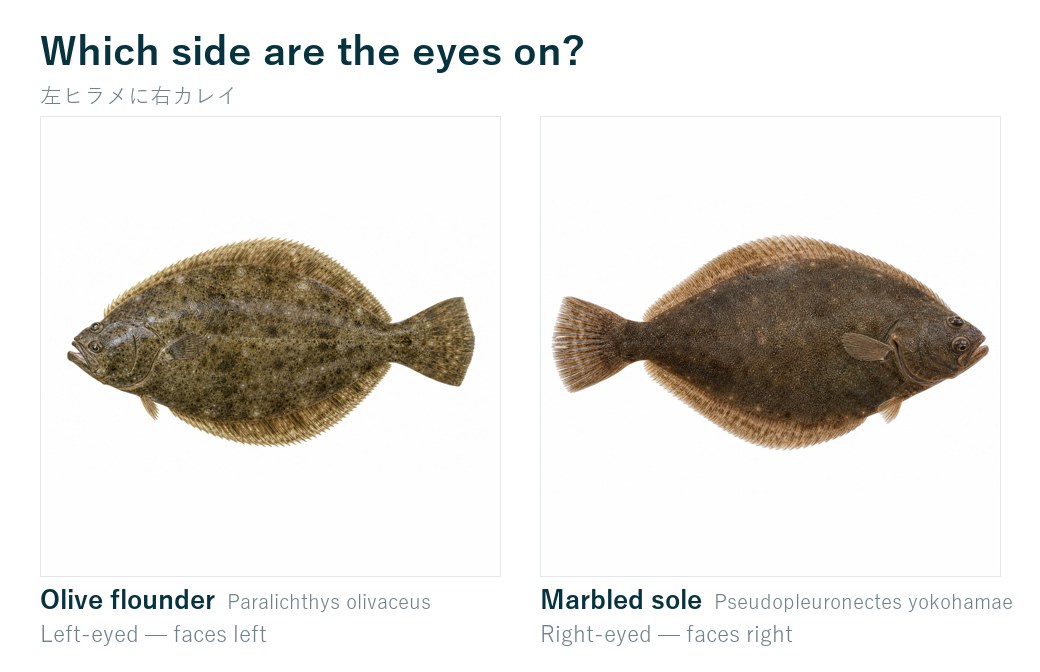
昔から言う「左ヒラメに右カレイ」。目安としてよくできた覚え方です。
直したのは20種
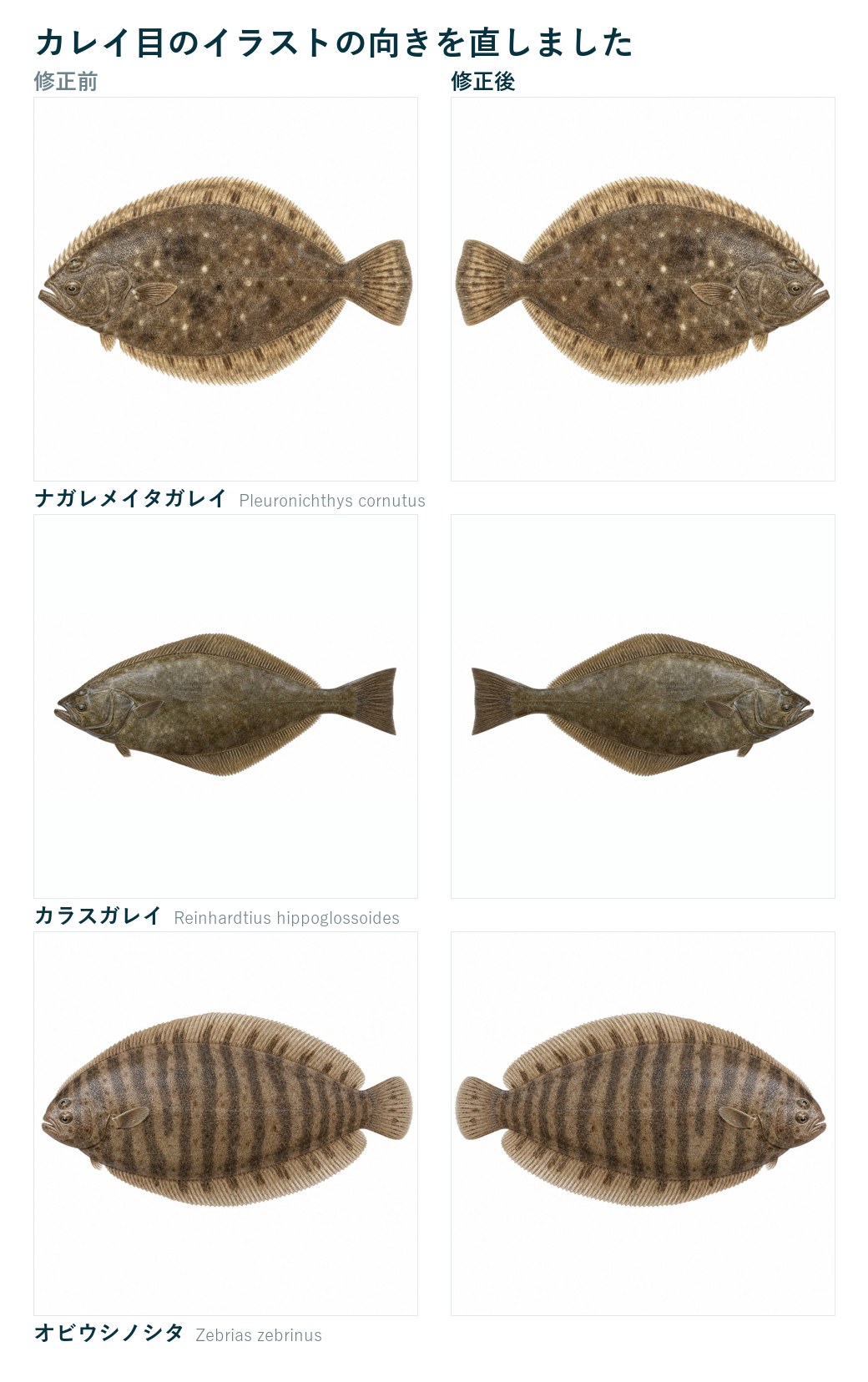
点検の結果、カレイ科17種(サメガレイ、ヒレグロ、コガネガレイ、カラスガレイ、クロガシラガレイ、ナガレメイタガレイなど)と、ササウシノシタ科3種(ミナミウシノシタ、オビウシノシタ、ヨーロッパの Solea solea)が左向きのままになっていました。この20種を左右反転しています。
反転はイラストを描き直すのではなく、そのまま鏡に映す処理です。絵柄も体の模様も色も、まったく変わっていません。
生まれたときは、目が両側にあります
ここからが、この魚たちのいちばん面白いところです。
カレイ目の稚魚は、生まれたばかりのころはほかの魚と同じように左右対称で、背中を上にして普通に泳いでいます。それが成長の途中で、片方の目が頭を越えて反対側へ移動していく。目の引っ越しが終わると体を横に倒し、そのまま海底での暮らしに移っていきます。体をひねって横向きに寝ているのではなく、横になった姿勢に合わせて顔の造りのほうが作り変えられているわけです。何度聞いても、よくそんなことを思いついたものだと感心します。
そして、どちらの目が動くかは、種ごとにだいたい決まっています。ヒラメの仲間は左に、カレイの仲間は右に。「左ヒラメに右カレイ」は、この性質を言い当てた言葉です。
ただし、例外もいます
- ウシノシタ科は左、ササウシノシタ科は右。 名前は似ていますが、目の寄る側は逆です。今回の20種にササウシノシタ科が3種含まれていたのは、この紛らわしさが理由でした。
- ヌマガレイは、カレイの仲間なのに左。 日本近海のヌマガレイはほとんどが目が左に寄っています。図鑑でもこの種だけは左向きのままにしてあります。「右カレイ」の例外として、覚えておくと楽しい魚です。
- ヒラメやカレイでも、まれに逆側に目が寄る個体が現れます。生き物の決まりごとは、いつもきれいに割り切れるわけではないようです。
図鑑は、細部から育てていきます
向きが逆でも魚は見分けられますし、実用上はどちらでも困りません。それでも図鑑と名乗る以上、絵が語ってしまう情報にも嘘がないようにしたいと思っています。53種を並べて1種ずつ見比べる作業は、正直かなり地味でしたが、おかげでカレイ目のことをずいぶん好きになりました。
おかしなイラストや解説を見つけたら、ぜひ教えてください。アプリのメニューの「報告・お問い合わせ」から送っていただけます(魚種名を書き添えていただけると助かります)。いただいた指摘はひとつずつ確認して、直したものはこのお知らせでご報告していきます。
ご注意
- アプリでは、図鑑の画面を開き直すと新しいイラストが表示されます。この Web の魚図鑑では、以前に表示した画像がブラウザに残っていることがあります(その場合はページの再読み込みで新しいイラストになります)。
- 解説の一部は AI による下書きで、順次見直しを進めています。魚種の同定や食用可否・毒の有無などは、安全のため必ず実物・専門家の確認をお願いします。
- 名称・分類データは GBIF を出典としています。図鑑のイラストの著作権は世界釣りマップに帰属します。無断転載・二次利用はご遠慮ください。
We went through the artwork for all 53 flatfish species (order Pleuronectiformes) in the Fish Encyclopedia, one species at a time, and mirrored 20 of them so that they face the right way. It looks like a small cosmetic change — but for a flatfish, which way it faces says something real about its body.
Every illustration shows the eyed side
A flatfish has both eyes on one side of its body, and it lies on the seabed with that side facing up. Only the eyed side carries colour and pattern; the underside is pale. So every illustration in the encyclopedia shows the fish from its eyed side.
That means the direction the fish faces is itself a piece of information: it tells you which side the eyes are on. Left-eyed species face left, right-eyed species face right. We made that the rule for the whole encyclopedia, and then checked all 53 species against it.
There is an old Japanese saying for this: hidari-hirame ni migi-karei — "flounder to the left, sole to the right."
Twenty species corrected
The audit turned up 17 species in the family Pleuronectidae (roughskin sole, Korean flounder, yellowfin sole, Greenland halibut, cresthead flounder, frog flounder and others) and 3 species in the family Soleidae (ocellated sole, banded sole and the common sole) still facing left. All 20 have now been mirrored.
Mirroring is not a redraw — the artwork is simply flipped. The style, the markings and the colours are exactly as they were.
They are born with an eye on each side
This is the part we find genuinely wonderful.
A flatfish larva starts life symmetrical, like any other fish, swimming upright with one eye on each side. Then, as it grows, one eye migrates across the top of the head to join the other. Once the journey is over, the fish tips onto its side and settles into life on the seabed. It is not simply a fish lying down — its whole face has been rebuilt around the new posture.
Which eye makes the trip is largely fixed per species: to the left in the flounders, to the right in the soles and dabs. The old saying above is just a compact way of remembering that.
But there are exceptions
- Cynoglossidae are left-eyed; Soleidae are right-eyed. Their Japanese names are nearly identical, which is precisely why three Soleidae had slipped through unnoticed until now.
- The starry flounder is a right-eyed family member that is usually left-eyed. Around Japan, almost all starry flounders have their eyes on the left, so this one species stays facing left in the encyclopedia.
- Individual fish occasionally turn up reversed, whatever their species. Nature rarely draws its rules quite as cleanly as we would like.
An encyclopedia is built out of details
You can identify a fish perfectly well from a mirrored picture, and nothing practical was broken. But if we are going to call it an encyclopedia, the things the picture says by implication should be true as well. Comparing 53 species one by one was slow work — and it left us rather fond of flatfish.
If you spot an illustration or a description that looks wrong, please tell us — use "Report / Contact" in the app menu (mentioning the species name helps a lot). We check every report one by one, and we will keep announcing the fixes here.
Notes
- In the app, reopening the encyclopedia screen shows the new illustrations. On this website, a previously viewed image may still be cached by your browser — reload the page to see the updated artwork.
- Some descriptions are AI-generated drafts that we are reviewing over time. For safety, always confirm identification and edibility/toxicity with the real specimen or an expert.
- Names and taxonomy are sourced from GBIF. The encyclopedia illustrations are © World Fishing Map; please do not reproduce or reuse them without permission.