
魚図鑑に、はじめてクラゲの仲間100種を追加しました。収録数は合計約2,650種になります。
これまで図鑑は、魚のほかにエビ・カニ、イカ・タコ、貝の仲間を収めてきましたが、今回はさらに一歩ふみ出して刺胞動物(しほうどうぶつ)――いわゆるクラゲの世界へ。海辺で必ず出会うのに、名前まではなかなか分からない。そんな存在を、1種ずつイラストに描き起こしました。
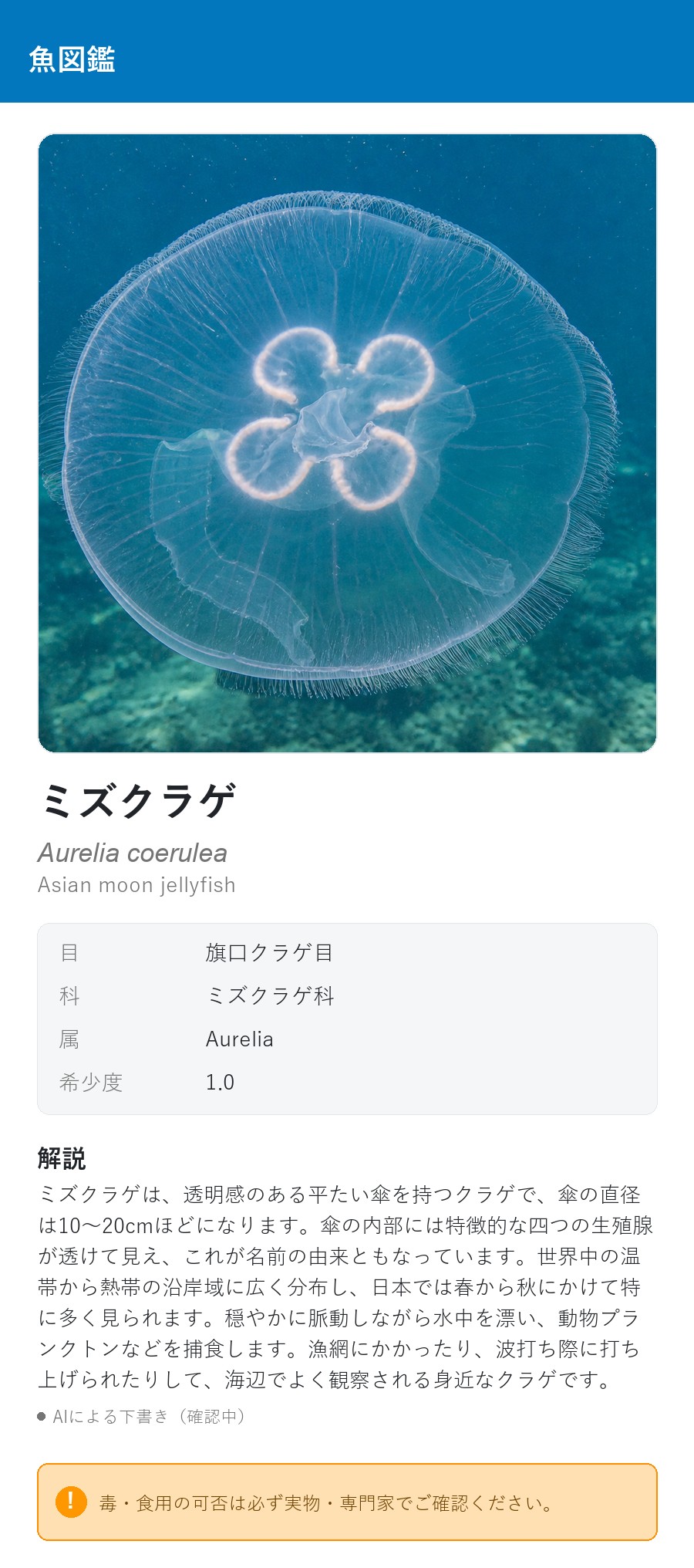
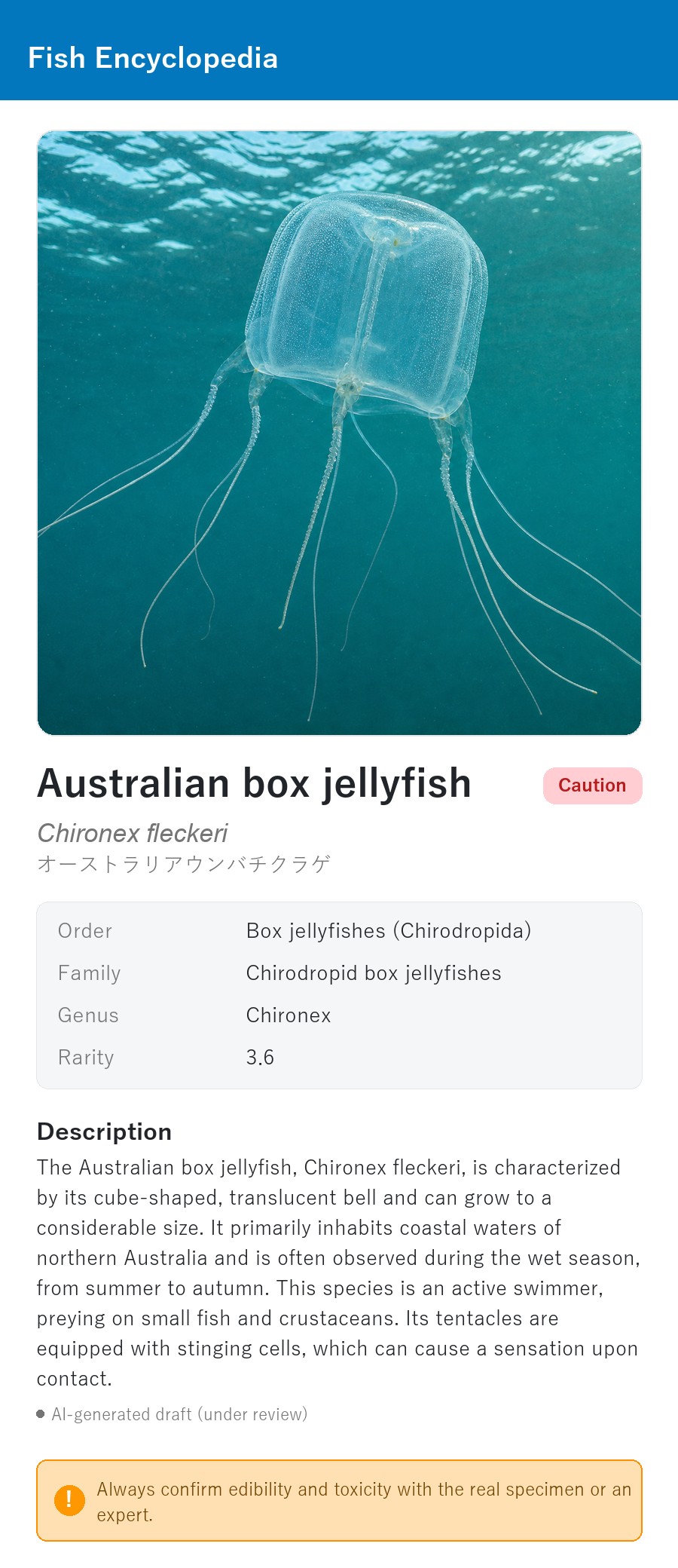
アプリの魚図鑑での表示イメージ。日本語・英語どちらの表示にも対応しています。
新たに加わったおもな仲間
- 海辺で出会う身近なクラゲ — 内湾を埋めつくす「ミズクラゲ」、春の海で刺傷の多い「アカクラゲ」、水玉模様の「タコクラゲ」、逆さまに着底する「サカサクラゲ」など。
- 食卓にのぼるクラゲ — 中華クラゲの最高級品「ビゼンクラゲ」、有明海の「ヒゼンクラゲ」、傘の直径2mに達する世界最大級の「エチゼンクラゲ」など、漁業の対象となる仲間も。
- 注意したい危険なクラゲ — 沖縄の「ハブクラゲ」、世界で最も危険とされる「オーストラリアウンバチクラゲ」、1cmほどしかない「イルカンジクラゲ」、浜辺に打ち上がる「カツオノエボシ」など。
- ふだん見られない深海・外洋のクラゲ — 光を放つ深海の「ヒラタカムリクラゲ」、兜のような姿の「クロカムリクラゲ」、帆を立てて漂う「カツオノカンムリ」など。
- 数ミリの小さなクラゲたち — 発生生物学のモデル生物にもなっている Clytia hemisphaerica、藻場に潜む「カギノテクラゲ」、汽水域の「キスイクラゲ」など。
クラゲならではの工夫
- 「毒」の表示は、警告が必要な種にだけ。 クラゲはすべて刺胞(しほう)を持っていますが、一律に毒マークを付けると警告の意味が薄れてしまいます。そこで、重篤な事故の報告がある箱虫類(ハブクラゲの仲間)と、刺傷被害が報告されている種にかぎって表示しています。毒マークが無いことは「刺されない」という意味ではありません。
- 「美味しさ」は食用として流通する種に。 中華クラゲとして実際に流通する20種に評価を付けました(いずれも塩蔵などの加工を経て食べるもので、生のまま食べるものではありません)。
- 希少度は「出会いやすさ」で。 クラゲは釣りの対象ではないため、分布の広さや個体数、見つけやすさをもとに設定しています。
ご注意
- クラゲの毒性の判断は、必ず実物と専門家の確認をお願いします。 図鑑の表示は参考情報であり、安全を保証するものではありません。生きている個体はもちろん、浜に打ち上げられた個体や切れた触手にも刺胞が残っています。
- 標準的な和名が無い種は、英名(無い場合は学名)で表示します。
- 解説の一部は AI による下書きで、順次見直しを進めています。
- 名称・分類データは GBIF を出典としています。図鑑のイラストの著作権は世界釣りマップに帰属します。無断転載・二次利用はご遠慮ください。
We have added 100 jellyfish species to the Fish Encyclopedia for the very first time, bringing the total to about 2,650 species.
Until now the encyclopedia covered fish alongside crustaceans, cephalopods and shellfish. This update takes a step further into the cnidarians — the jellyfish. They are impossible to miss at the shore, yet surprisingly hard to name. We have illustrated each one individually.
How species look in the app encyclopedia — available in both Japanese and English.
What's new
- Familiar jellyfish of the shoreline — the moon jellyfish that fills sheltered bays, the Japanese sea nettle behind many spring stings, the spotted jellyfish, and the upside-down jellyfish that rests bell-down on the seabed.
- Jellyfish on the table — the premium edible Rhopilema esculentum, the sand jellyfish of the Ariake Sea, and Nomura's jellyfish, which reaches two metres across.
- Dangerous species to know — the habu box jellyfish of Okinawa, the Australian box jellyfish regarded as the most venomous of all, the one-centimetre Irukandji, and the Portuguese man o' war that washes up on beaches.
- Deep-sea and open-ocean jellyfish — the bioluminescent Atolla jellyfish, the helmet jellyfish of the deep, and the by-the-wind sailor that drifts under its own sail.
- The tiny ones, just millimetres across — Clytia hemisphaerica, a model organism in developmental biology, the clinging jellyfish of seagrass beds, and estuarine hydromedusae.
How we handled jellyfish differently
- The venom marker appears only where a warning matters. Every jellyfish carries stinging cells, so flagging all of them would drain the warning of meaning. We mark the box jellyfish — whose stings have caused severe incidents — and species with documented sting injuries. The absence of the marker does not mean a species cannot sting.
- Culinary ratings go to species genuinely sold as food — 20 species traded as edible jellyfish, all of which are salted or otherwise processed rather than eaten raw.
- Rarity reflects how likely you are to encounter them. Jellyfish are not angling targets, so we calibrated the coefficient on range, abundance and how easy they are to spot.
Notes
- Always confirm venomousness with the real specimen and an expert. Entries in the encyclopedia are reference information and are not a guarantee of safety. Stinging cells remain active on stranded animals and detached tentacles.
- Species without a standard Japanese name are shown by their English name (or scientific name if none exists).
- Some descriptions are AI-generated drafts that we are reviewing over time.
- Names and taxonomy are sourced from GBIF. The encyclopedia illustrations are © World Fishing Map; please do not reproduce or reuse them without permission.